Foreword
About This Book
You've run workshops. Maybe a handful, maybe dozens. You know they work — you've seen teams align in hours instead of weeks, watched decisions stick because everyone was in the room when they were made, felt the difference between a team that thought together and one that didn't.
But knowing workshops work and proving it are two different things.
This book is for the person who needs to make the case. The design lead who wants to embed workshops into their team's process. The product manager who needs to justify four hours of eight people's time to a VP who thinks meetings are waste. The design ops manager building a facilitation practice across an organization. The executive who senses that collaborative decision-making is better but needs numbers before committing resources.
You'll learn how to measure workshop impact at four levels — from immediate participant satisfaction to long-term business outcomes. You'll get ROI calculation frameworks with actual numbers. You'll see case studies of organizations that transformed from workshop-skeptical to workshop-driven. And you'll get a practical playbook for scaling facilitation beyond one person running occasional sessions.
This isn't philosophy. It's the business case for thinking together, backed by frameworks you can use starting this week.
Part 1 · Proving Workshop Value · Chapter 1
The Real ROI of Workshops
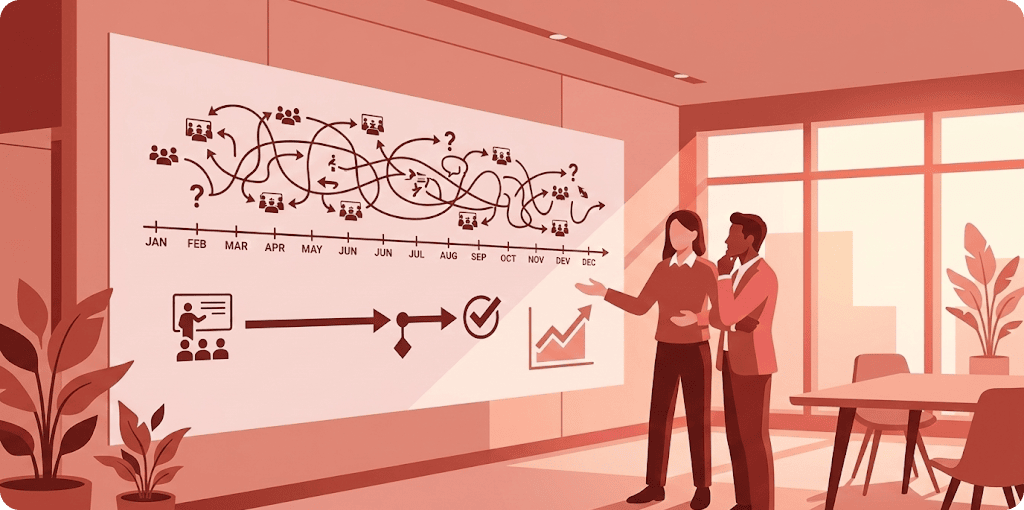
You've got a problem. You know that running a design workshop would actually solve it. But you have to convince the people above you, beside you, or who control the calendar. And they're skeptical.
These are real objections from real stakeholders. And if you go into the conversation without a clear frame for why workshops matter, you'll lose. The skeptics will out-argue you because you'll be arguing from "this feels right" while they're arguing from "this costs money and time."
You need a different strategy. You need to frame workshops not as feel-good collaboration, but as a high-ROI investment in reducing risk and accelerating decisions.
The real ROI of collaborative design
Here's the unsexy truth about design decisions: the quality of the decision matters a lot less than the alignment behind the decision.
I know that sounds wrong. You want to make the right decision, not just an aligned one. But here's what actually happens in most organizations:
The design team spends three weeks crafting a proposal. They present it in a meeting. The room looks uncertain. The product manager has doubts but doesn't say anything in the meeting. The CEO likes 60% of it but wanted something different. Nobody said this out loud, so nobody knows. Then, two weeks into execution, the doubts surface. The direction shifts. Work gets thrown out. The timeline extends. You end up with worse outcomes and wasted time.
Now imagine the alternative: Two hours in a room, thinking together. Real disagreements surface immediately. You hash them out right then. Everyone understands the tradeoffs and the reasoning. When you walk out, there's actual alignment. When you start executing, there's no "wait, I thought we were going a different direction" conversation. The doubts got resolved in real-time, not in retrospective emails.
The ROI isn't that the outcome is marginally better. The ROI is that you move faster because you don't have to rework the decision three times. You have fewer meetings about the same topic. You spend less time in back-channel conversations trying to get buy-in you should have had from the start.
And here's the second part of the ROI: risk reduction.
When a design decision is made in a silo — even if it's a well-informed silo — you miss things. You miss constraints the engineer knows about. You miss context the marketer has. You miss objections that would derail launch if you'd found them later. You don't know how the business will handle scale or edge cases. You miss the obvious thing that someone in ops sees immediately but design never thought about.
Running a collaborative workshop surfaces all this stuff early, while you can still do something about it. You catch the problems that would have cost you a launch delay if you'd found them three weeks into implementation.
That's risk reduction. That's the ROI.
Frame it this way to skeptics
When you're pitching the workshop, don't lead with "it'll be fun and we'll all feel aligned." Lead with this:
Notice what's not in there: "it'll boost morale," "we'll get to know each other better," "it'll be a great team building experience." Those might be nice side effects, but they're not the pitch. The pitch is efficiency and risk reduction.
And then you need to be specific. Not "we'll run a workshop." "We'll spend four hours on Tuesday, March 12th, getting the heads of design, engineering, and product in a room to workshop the approach for [specific problem]. We'll leave with a clear decision and a shared understanding of the tradeoffs."
Handling specific objections
"We don't have time."
This is the most common one. Here's how to reframe it:
Then show the math if you can.
"The design team can just figure this out."
This one reveals a misunderstanding about what design thinking is.
"I'm busy that day."
You need a specific decision-maker in the room. If they're not there, you don't have buy-in. So you schedule around them, or you move the workshop.
"How will we measure success?"
This is actually a great question. Here's a good answer:
And for a more sophisticated answer, point them to Chapter 2 of this book — the 4-Level Measurement Model gives you concrete metrics at every level.
The template pitch email
Hi [Stakeholder/Group],
I'm proposing we run a focused workshop on [specific problem/decision] on [date], [time], [location or Zoom link].
Why now: We're at the point where we need to make a decision on [topic]. There are legitimate tradeoffs between different approaches, and the right answer depends on input from multiple disciplines.
Who needs to be there: [List specific roles — this should be 5–10 people max]
What we'll do: We'll spend [X hours] getting aligned on the problem, exploring options, understanding the constraints and priorities each person brings, and walking out with a clear decision and a shared understanding of why we chose it.
What we'll deliver: A documented decision, the reasoning behind it, and a list of next steps.
Why this matters: If we make this decision without alignment, we risk rework and course-correction down the line. This workshop ensures we're moving together, which saves time overall and reduces risk.
Let me know if you can commit to being there. If [date] doesn't work, let me know what does.
What to do if they still say no
Sometimes they won't want to do it. They'll want you to just make a recommendation and send it to them.
In that case, you make the recommendation. But you document the fact that you offered a workshop and they declined. Because when the direction shifts, when there's disagreement on implementation, when the decision needs to change mid-project — and one of these things almost always happens — you'll have clear documentation that you tried to surface alignment early.
And then next time, when they feel the pain of an unaligned decision, they'll remember the workshop offer and they'll say yes.
The bottom line
Workshops aren't an indulgence. They're not a luxury you run when you have time and good energy. They're a tool for making better decisions faster and reducing risk. Once you frame them that way — not as a team-building activity, but as a business efficiency tool — skeptics become easier to convince.
Because at the end of the day, people care about moving fast and making good decisions. Workshops do both. You just have to know how to say it.
Case study
How a Junior Designer Convinced a VP Who Hated Workshops
Dani was two years into her design career at BrightEdge, a marketing analytics platform. The VP of Product, Richard, was not a workshop person. "I've been in too many workshops that produce nothing but sticky notes and false consensus. Just tell me what the data says and I'll make the call."
Dani knew she couldn't walk into Richard's office and say "we should run a workshop." She needed to speak his language. She went through the last four quarters of product decisions and found three features that needed significant rework because constraints or customer insights surfaced late — roughly 340 hours of engineering time, plus delayed revenue from slipped launches.
Then she wrote the email. Not a workshop pitch. A business efficiency pitch: "I'd like to propose a focused 3-hour session before we lock the Q3 roadmap. Not a brainstorming workshop — a structured decision session where we surface constraints from engineering, customer insights from success, and business priorities from you, before we commit. If we catch even one of those late-stage pivots early, we save roughly 100 engineering hours. That's the ROI of three hours in a room."
Richard replied in four minutes: "Tuesday works. Keep it tight."
Dani kept it tight. No icebreakers — Richard would have walked out. She opened with Richard presenting his top three Q3 priorities, then ran a structured pre-mortem: "Imagine it's six months from now and this feature failed. What went wrong?" The engineering lead flagged a data migration dependency that would have added eight weeks. The customer success manager shared feedback from three enterprise clients that contradicted a planned feature's assumptions. Richard adjusted two of his three priorities.
At the end, he said something Dani didn't expect: "This was useful. Not because the process was fun — I still don't like sticky notes — but because I made a better decision in three hours than I would have made in three weeks of one-on-ones." Dani ran four more sessions that year. By Q4, Richard was requesting them.
What this teaches us: Selling workshops to skeptics isn't about convincing them that workshops are valuable in the abstract. It's about connecting a specific workshop to a specific business pain they already feel. Dani didn't sell "collaboration." She sold "we'll stop wasting 100 engineering hours per quarter." That's a pitch even a workshop-hating VP will take.
Part 1 · Chapter 2
The 4-Level Measurement Model
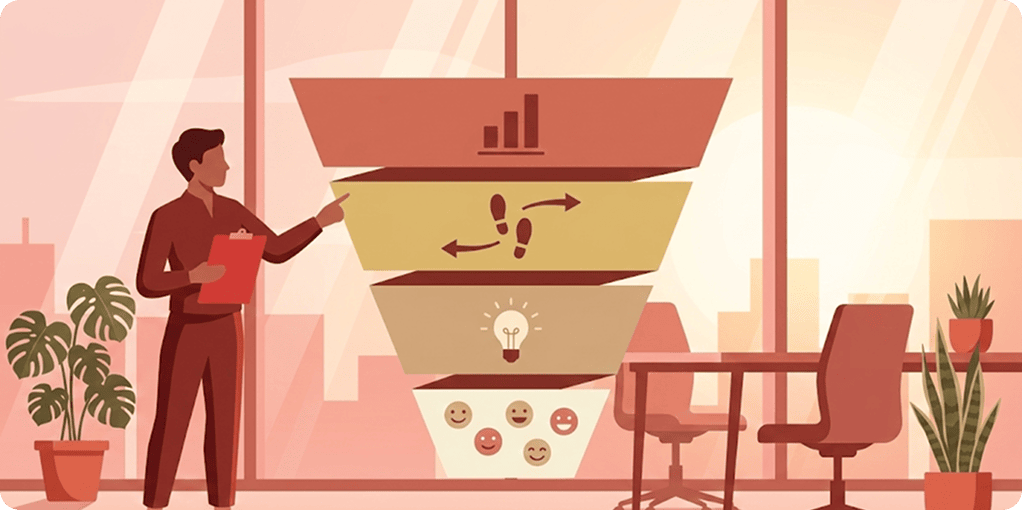
"How do we know the workshop actually worked?"
If you can't answer this question with something more specific than "people seemed engaged" or "the room had good energy," you'll never build a sustainable case for workshops. You need a measurement framework.
The model below is adapted from Kirkpatrick's training evaluation framework, widely used in organizational development. It gives you four progressively deeper levels of measurement — from immediate reactions to long-term business results. Most teams stop at Level 1. The teams that prove workshop ROI measure at Levels 3 and 4.
Level 1: Reaction — Did Participants Find It Valuable?
This is the easiest level to measure, and the least meaningful on its own. But it's your starting point.
What you're measuring: Participant satisfaction, perceived value, engagement quality. When: Immediately after the workshop (one-word close) and within 24 hours (short survey).
One-Word Close (in-room, real-time): At the end of the workshop, go around the room. Each person says one word that describes how they feel. Write the words down. This takes 3 minutes and gives you an instant signal. Words like "clear," "energized," and "aligned" are positive. Words like "confused," "overwhelmed," or "skeptical" tell you there's work to do.
Quick Survey (within 24 hours): Send a 3-question survey. More than 3 questions and completion rates drop below 50%.
- Was this workshop a good use of your time? (1–5 scale)
- How clear are you on the decisions we made? (1–5 scale)
- What's one thing you'd change about how the session was run? (open text)
Target benchmarks:
- Average satisfaction score of 4.0+ out of 5
- 80%+ of participants rating it a "good use of time"
- Zero participants saying they're unclear on decisions made
Limitations: Level 1 tells you whether people liked the workshop, not whether it worked. A workshop can be enjoyable and produce nothing. A workshop can feel uncomfortable and produce breakthrough decisions. Use Level 1 as a hygiene check, not a success metric.
Level 2: Learning — Did Understanding Improve?
This level measures whether the workshop actually shifted how people think about the problem. Did alignment increase? Did the group develop shared understanding that didn't exist before?
What you're measuring: Decision clarity, assumption alignment, shared understanding of the problem space. When: End of workshop (capture exercise) and 48 hours after (follow-up check).
Decision Clarity Check: Before closing the workshop, ask each participant to write down (individually, on paper) the answers to three questions:
- What decision did we make today?
- Why did we make this decision?
- What's my specific next step?
Collect the papers. If all 8 participants wrote essentially the same answers, you have alignment. If 3 wrote different decisions, you have a problem to fix before people leave the room.
Assumption Alignment Test: Before the workshop, send participants 5 key assumptions related to the problem ("Our biggest customer pain point is X," "The technical constraint is Y"). Ask them to rate agreement 1–5. After the workshop, send the same 5 statements. If the variance between participants decreased, the workshop created alignment. If it didn't, the workshop surfaced disagreement but didn't resolve it.
Target benchmarks:
- 90%+ of participants articulate the same decision
- 80%+ agree on the reasoning behind it
- Assumption alignment variance decreases by at least 30%
Level 3: Behavior — Did Work Practices Change?
This is where measurement gets meaningful. Level 3 asks: did the workshop actually change what people do?
What you're measuring: Action item completion, decision-making speed, rework reduction, process changes. When: 2 weeks, 4 weeks, and 8 weeks after the workshop.
Action Item Completion Rate: Track the specific action items assigned at the end of the workshop. What percentage were completed on time? What percentage were completed at all?
| Timeframe | Target |
|---|---|
| 1 week post-workshop | 60%+ of action items started |
| 2 weeks post-workshop | 80%+ of action items completed |
| 4 weeks post-workshop | 95%+ completed or explicitly deprioritized |
Decision Durability: Did the decisions made in the workshop hold? Track whether the team reversed, significantly modified, or upheld the workshop decisions over the following 8 weeks. A "decision durability rate" above 80% means your workshop is producing real alignment, not false consensus.
Process Metrics: Track before-and-after comparisons: the number of follow-up meetings needed to re-discuss the same topic, time from decision to implementation kickoff, direction changes during implementation, stakeholder escalations — all should decrease.
Target benchmarks:
- 80%+ action item completion within 2 weeks
- 80%+ decision durability at 8 weeks
- 30%+ reduction in follow-up alignment meetings
- Measurable decrease in implementation direction changes
Level 4: Results — Did Business Outcomes Improve?
This is the level that executives care about. It's also the hardest to measure because workshops are rarely the only factor in a business outcome. But you can build a credible case.
What you're measuring: Time-to-market, customer satisfaction, revenue impact, cost reduction, quality improvement. When: 3–6 months after the workshop.
- Time-to-Market Impact: Compare the timeline of projects that included a workshop to similar projects that didn't. If workshop-informed projects consistently ship 2–3 weeks faster, that's measurable value.
- Rework Cost Reduction: Track engineering hours spent on rework and direction changes. Even a rough estimate is valuable: "Our last three projects without workshops averaged 120 hours of rework. Our last three with workshops averaged 40 hours."
- Customer Outcome Metrics: You can't claim the workshop caused the result, but you can credibly link it: "The workshop aligned the team on the approach, which shipped on time, and customer satisfaction increased 18%."
- Meeting Reduction: Teams that workshop effectively often eliminate 30–50% of their status and alignment meetings.
Target benchmarks (these vary significantly by context):
- 15–25% reduction in time from decision to launch
- 40–60% reduction in rework hours
- 30–50% fewer alignment meetings in the quarter following the workshop
- Positive movement in relevant customer metrics
The Workshop Impact Scorecard
Use this template after every workshop. It takes 10 minutes to fill out immediately after, and 5 minutes to update at each checkpoint.
| Metric | Measurement | Score |
|---|---|---|
| Level 1: Reaction | ||
| Satisfaction (1–5) | Average survey score | __ / 5 |
| Time well-spent? | % saying yes | __ % |
| One-word sentiment | Positive / neutral / negative | ____ |
| Level 2: Learning | ||
| Decision clarity | % aligned on decision | __ % |
| Assumption alignment | Variance decrease | __ % |
| Level 3: Behavior | ||
| Action items completed (2 wk) | % completed | __ % |
| Decision durability (8 wk) | Held / modified / reversed | ____ |
| Follow-up meetings needed | Count vs. baseline | ____ |
| Level 4: Results | ||
| Time-to-market impact | Days saved vs. estimate | ____ |
| Rework hours avoided | Estimated hours | ____ |
| Customer metric movement | Specific metric change | ____ |
Track this scorecard across workshops and you'll build a dataset that makes the case for you. After 5–10 workshops, the patterns become clear — and you'll have the numbers to prove what you've always known: workshops aren't just good process.
They're good business.
Part 1 · Chapter 3
Making the Business Case
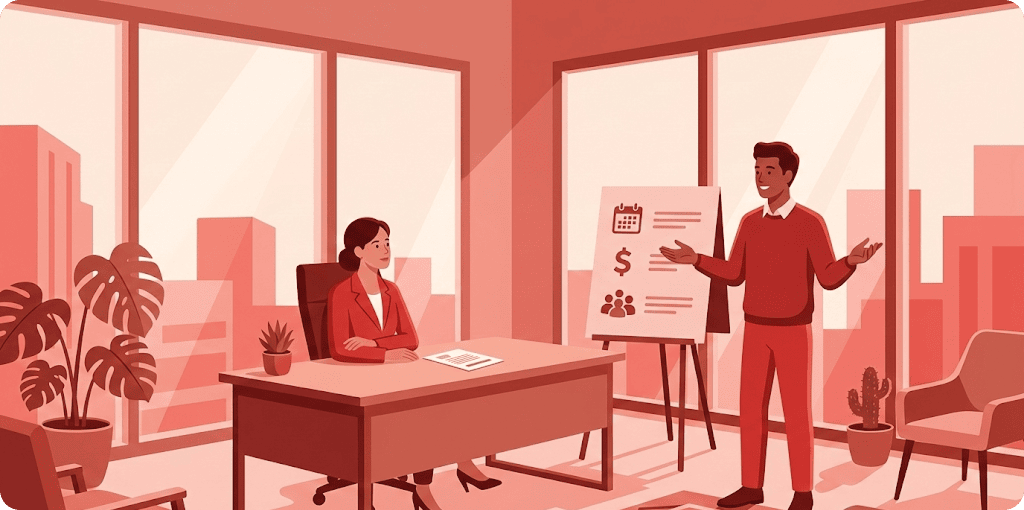
Executives don't fund feelings. They fund returns. If you want to scale workshops beyond occasional one-offs, you need to show the math.
This chapter gives you the framework, the formulas, and three worked examples you can adapt for your own organization.
The Workshop Cost Formula
Every workshop has a cost. Being honest about it builds credibility.
Direct costs: participant time (people × hours × average hourly rate), facilitator prep time, materials, space, technology subscriptions, and travel. Opportunity cost: what participants would have been working on instead, and deadlines pushed to accommodate the workshop.
Example calculation for a full-day workshop with 8 participants:
| Cost item | Calculation | Amount |
|---|---|---|
| 8 participants × 7 hours × $75/hr | Participant time | $4,200 |
| 1 facilitator × 12 hours × $75/hr | Prep + facilitation | $900 |
| Materials and food | Flat estimate | $200 |
| Total direct cost | $5,300 |
That $5,300 sounds like a lot when you say "we want to run a workshop." It sounds like nothing when you compare it to what it prevents.
The Workshop Value Formula
The value of a workshop comes from three sources: decisions accelerated, rework prevented, and alignment gained.
- Decisions Accelerated: Without a workshop, how long does a comparable decision take? Count the meetings, email threads, Slack debates, one-on-ones. Formula: hours of scattered decision-making avoided × average hourly rate.
- Rework Prevented: When decisions are made without alignment, how often does the team redo work? Formula: probability of rework × average rework cost.
- Alignment Gained: How many hours per week does your team spend in status meetings and "making sure everyone's on the same page" conversations? Formula: meeting hours eliminated per week × weeks of impact × people × hourly rate.
Three Worked Examples
Half-day discovery workshop
Cost $2,400 → value $24,600. Decision in 1 day instead of 3 weeks of scattered meetings; rework risk cut from ~40% to ~10%.
Full-day prioritization workshop
Cost $7,500 → value $48,500. One revision cycle instead of four; 120 person-hours saved; launch delay cut from 4 weeks to 0–1.
2-day design sprint
Cost $12,750 → value $54,750. User feedback in 5 days instead of 8 weeks; $42,000 of wasted engineering prevented.
Example 1: Half-Day Discovery Workshop
Context: Product team needs to align on customer problems before starting a new feature. Without a workshop, this typically takes 3 weeks of scattered meetings.
| Without workshop | With workshop | |
|---|---|---|
| Decision timeline | 3 weeks | 1 day |
| Meetings required | 8 meetings × 6 people × 1 hr | 1 workshop × 6 people × 4 hrs |
| Total person-hours | 48 hours | 24 hours |
| Rework risk | ~40% chance of significant pivot | ~10% chance |
| Expected rework cost | $12,000 (40% × $30,000) | $3,000 (10% × $30,000) |
Workshop cost: $2,400 (6 people × 4 hours × $75/hr + $600 prep/materials). Value created: $24,600 (person-hours saved: $1,800 + rework prevented: $9,000 + 2 weeks faster decision: $13,800 in accelerated launch value). Net ROI: $22,200 or 925%.
Example 2: Full-Day Prioritization Workshop
Context: Leadership team needs to decide Q2 priorities. Without a workshop, the roadmap typically goes through 4 revision cycles.
| Without workshop | With workshop | |
|---|---|---|
| Revision cycles | 4 rounds over 6 weeks | 1 round over 1 week |
| People involved | 10 people × 20 hrs each | 10 people × 8 hrs each |
| Total person-hours | 200 hours | 80 hours |
| Launch delay | 4 weeks average | 0–1 week |
Workshop cost: $7,500 (10 people × 7 hours × $85/hr + $1,550 prep/materials). Value created: $48,500 (120 hours saved at $85/hr: $10,200 + 3 weeks earlier launch: $38,300 in revenue acceleration). Net ROI: $41,000 or 547%.
Example 3: 2-Day Design Sprint
Context: Team is debating whether to build a major new feature. Without a sprint, the team would build a full prototype over 8 weeks, then user test.
| Without sprint | With sprint | |
|---|---|---|
| Time to user feedback | 8 weeks | 5 days |
| Engineering investment before validation | $120,000 | $0 |
| Risk of building wrong thing | ~35% | ~10% (validated by testing) |
| Expected wasted cost | $42,000 | $0 |
Sprint cost: $12,750 (6 people × 2 days × $85/hr + $2,550 prep/materials). Value created: $54,750 (wasted engineering prevented: $42,000 + 7 weeks faster feedback: $12,750 in time value). Net ROI: $42,000 or 329%.
The Workshop Business Case Template
Use this one-pager when you need approval:
The problem: [Specific decision or alignment gap that needs resolving]
Current cost of inaction: [Hours being spent in meetings, rework cycles, delayed decisions — with estimated dollar amounts]
Proposed workshop: [Format, duration, participants, date]
Workshop cost: [Total cost calculated using the formula above]
Expected value:
· Decisions accelerated by [X weeks], saving [$ amount]
· Rework risk reduced from [X%] to [Y%], preventing [$ amount]
· [X] alignment meetings eliminated, saving [hours/week] for [Y weeks]
Net expected ROI: [$ amount or percentage]
Measurement plan: We'll track [specific metrics from the 4-Level Model] at [specific intervals].
Decision needed: Approval to schedule for [date] with [participants].
Tracking ROI Over Time
One workshop's ROI is an anecdote. Ten workshops' ROI is a trend. Create a simple spreadsheet:
| Workshop | Type | Cost | Value | ROI | Notes |
|---|---|---|---|---|---|
| Q2 Prioritization | Full-day | $7,500 | $48,500 | 547% | Roadmap held through Q2 |
| Onboarding Redesign | Half-day | $2,400 | $24,600 | 925% | Led to 40% faster ramp |
| Feature Validation | 2-day sprint | $12,750 | $54,750 | 329% | Killed feature before build |
After a quarter of tracking, you'll have the data to show: "Our workshops produce an average ROI of X%. Every dollar invested in workshop facilitation returns Y dollars in saved time and prevented rework."
That's not a feeling. That's a business case.
Part 2 · After the Workshop · Chapter 4
Converting Energy into Action
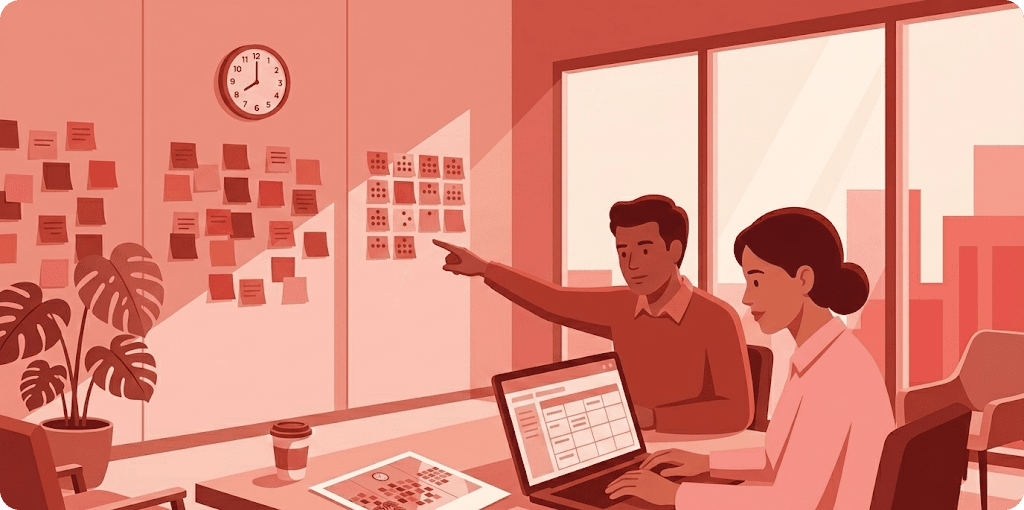
The workshop ended an hour ago. Participants are back at their desks, the energy is fading, and the sticky notes are starting to curl. What you do in the next 48 hours determines whether your workshop generates lasting impact or becomes a pleasant memory that changes nothing.
Post-Workshop Documentation Checklist Within 24 hours, while everything is fresh
How to Synthesize and Share Results
Your workshop output document should be scannable, not a wall of text. Use this structure:
- Workshop Summary (top of the document) — name and date, objective, outcome in one to two sentences, participants.
- Key Decisions — a bullet list. Each bullet is one decision, written as a clear statement: "We will focus the v2 release on the onboarding flow, not the dashboard redesign."
- Insights and Themes — organized by the clusters that emerged, with sticky note content grouped under theme headers and brief context where needed.
- Action Items — a table with four columns: Action, Owner, Deadline, Status. The status column gets updated over the following weeks.
- Parking Lot — items that came up but were not addressed, with a note on whether each will be followed up and by whom.
- Photos and Artifacts — embed or link to photos of the walls, exported boards, and sketches.
Follow-Up Email Template
Send this within 24 hours of the workshop.
Hi everyone,
Thank you for your time and energy in yesterday's workshop. Here is a summary of what we accomplished and what happens next.
What we achieved: [One to two sentences restating the outcome.]
Key decisions: [Decision 1] · [Decision 2] · [Decision 3]
Action items:
| Action | Owner | Deadline |
|---|---|---|
| [Action 1] | [Name] | [Date] |
| [Action 2] | [Name] | [Date] |
| [Action 3] | [Name] | [Date] |
If anything in this summary doesn't match your understanding, please reply and let me know. I want to make sure we're aligned before we move forward.
I'll check in on action item progress on [date, about one week out].
Thanks again, [Your name]
Getting Feedback on Your Facilitation
Separate product feedback (was the workshop useful?) from facilitation feedback (did I run it well?). They are different things.
For facilitation feedback, ask these three questions, either in a short survey or a quick 1:1 conversation with a trusted participant:
- Was the workshop a good use of your time? (This catches the big-picture issue.)
- Was there a moment you felt confused, bored, or frustrated? (This pinpoints specific problems.)
- What would you change about how I facilitated? (This invites direct, actionable feedback.)
Do not ask more than three questions. Do not ask them in the room at the end of the session; people are tired and will default to polite answers. Send the questions the next day.
Write down what you learn and review it before you plan your next workshop. Facilitation is a skill that improves through repetition and honest self-assessment, not through reading more books. Run workshops. Get feedback. Adjust. Repeat.
Part 2 · Chapter 5
Measuring Workshop Success
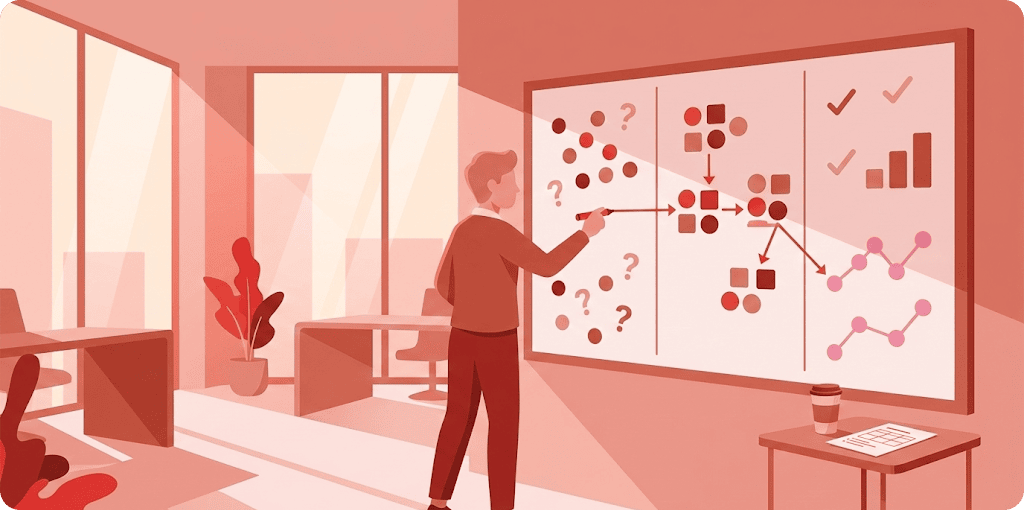
Track these metrics to understand whether your workshop actually worked:
Immediate (within 48 hours):
- Did you produce the tangible output stated in the objective? Yes or no.
- Participant satisfaction rating (a quick 1–5 scale survey, or simply note the one-word close responses).
- Number of action items with clear owners and deadlines assigned.
Short-term (within 2 weeks):
- Percentage of action items completed on time.
- Whether the decisions made in the workshop held or were reversed.
- Any follow-up sessions needed to address unresolved issues.
Long-term (within 1–3 months):
- Did the workshop output influence the final product/project direction?
- Was the time investment justified by the outcome? (Ask the decision-maker.)
- Did the team report feeling more aligned after the workshop?
Track it simply. A spreadsheet with one row per workshop and columns for these metrics is enough. Over time, you will see patterns: which workshop types produce the strongest outcomes, which formats your team prefers, and which activities consistently generate the best work.
Case study
The Workshop That Almost Died on Monday
Flux, a design agency specializing in healthcare UX, ran a brilliant two-day workshop with a hospital system client. Twenty-three people spent two days mapping patient journeys and converging on a redesign direction for the patient intake process. The closing round produced words like "transformative," "eye-opening," and "finally aligned."
Then Monday happened.
Elena, the facilitator, sent a thorough summary email Monday morning at 9:15 AM — within the 24-hour window, just as recommended. By Wednesday, she'd received zero replies. No progress on action items. Nothing. A week post-workshop, the clinical director had been "meaning to get to it," the IT manager hadn't started her assessment, and the patient experience officer "wasn't sure what the first step actually was."
The workshop was dying. Not because it was bad — it was one of the best Elena had ever facilitated. It was dying because the bridge between "workshop energy" and "Monday reality" is longer than anyone expects. She course-corrected with three moves:
Move 1: Personal follow-ups, not group emails. Elena called each action item owner individually. Not to nag — to help. "What's blocking you from starting?" The clinical director needed his admin to block two hours. The IT manager needed a clearer scope. The patient experience officer needed a template. Each unblocked that evening.
Move 2: A 30-minute checkpoint, not a status meeting. A quick video sync two weeks post-workshop, framed as "making sure we're still aligned." Reporting to peers created gentle accountability. Two of three action items were complete.
Move 3: A visible progress tracker. A simple shared document — Action, Owner, Status — updated weekly and sent to the full workshop group, not just the owners. The wider visibility created social motivation. Nobody wanted to be the red row.
Six weeks after the workshop, the hospital system had completed all initial action items and moved into prototyping. The clinical director told Elena: "The workshop gave us the direction. But your follow-up is what made it real. I've been in workshops before where we left excited and then nothing happened. This time was different because you didn't let us forget."
What this teaches us: A great workshop without follow-through is a pleasant memory. The 48-hour window is critical — not just for documentation, but for converting workshop energy into real-world momentum. Elena's three moves (personal unblocking, peer checkpoints, visible tracking) are the difference between a workshop that changes direction and a workshop that changes nothing.
Part 3 · Scaling Workshop Culture · Chapter 6
Scaling Facilitation in Your Org
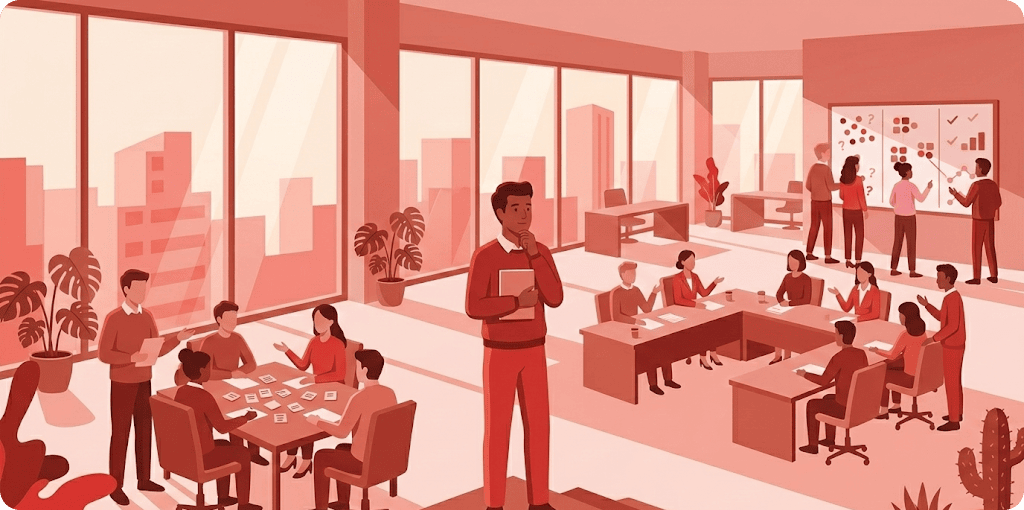
Running a great workshop is a skill. Building an organization where workshops are the default way decisions get made is a transformation. This chapter shows you how to move from "one person who runs workshops" to "an organization that thinks together."
The Facilitation Maturity Model
Organizations move through four stages when adopting workshop-driven decision-making. Understanding where you are helps you plan what's next.
Stage 1: Individual (One Hero Facilitator)
What it looks like: One person — maybe you — runs workshops occasionally. They're seen as "that person's thing," not an organizational practice. When the facilitator is busy, sick, or leaves the company, workshops stop. Signs you're here: only 1–2 people can facilitate, workshops happen irregularly, no consistent templates, and quality depends entirely on who's running it.
What to do: Document your process. Write down your go-to agenda templates, the activities you use most, and your facilitation notes. This documentation becomes the foundation for Stage 2.
Stage 2: Team (Multiple People Can Facilitate)
What it looks like: A small group (3–5 people) can facilitate workshops competently. They share techniques, debrief together, and cover for each other. Workshop culture exists within a team but hasn't spread. Signs: a shared folder of templates, teams that work with facilitators see the value while others remain skeptical, no formal training for new facilitators.
What to do: Start a co-facilitation program. Pair experienced facilitators with people who want to learn. Run debriefs after every workshop. Begin sharing results across teams.
Stage 3: Organizational (Workshops Are Embedded in Process)
What it looks like: Workshops are built into the organization's decision-making process. Product kickoffs include a workshop. Quarterly planning includes a workshop. Key decisions are made collaboratively, not unilaterally. Signs: 10+ people across the organization can facilitate, there's a shared playbook, leadership actively requests workshops, and new team members learn facilitation as part of onboarding.
What to do: Create a community of practice. Hold monthly facilitation retrospectives. Start measuring workshop ROI at the organizational level. Train managers to be good workshop participants, not just good facilitators.
Stage 4: Cultural (Collaborative Decision-Making Is the Default)
What it looks like: The organization doesn't "do workshops" — it thinks together as a default behavior. Meetings are structured. Decisions are transparent. Diverge-and-converge thinking is second nature. Signs: people facilitate impromptu structured conversations without calling them "workshops," new hires notice and comment on the collaborative culture, external partners request your facilitation approach, and facilitation is valued in performance reviews and career development.
What to do: Maintain and evolve. Share your approach externally. Contribute to the facilitation community. Continue measuring and improving.
How to Train Others to Facilitate
The fastest path to scaling facilitation is the "See One, Do One, Teach One" model borrowed from medical training.
See One: A new facilitator observes an experienced one run a full workshop. But not passively — they have a specific observation guide: How did the facilitator open the session? What did they do when energy dropped? How did they handle the person who dominated? What was their physical position in the room during different activities? What questions did they ask when the group got stuck? Debrief together after. Share the "why" behind every move.
Do One: The new facilitator runs a workshop with the experienced one in the room as a backup. The backup doesn't intervene unless specifically asked or unless something is going seriously wrong. After the workshop, the debrief focuses on: What worked? What felt awkward? What would you do differently?
Teach One: The now-competent facilitator mentors someone new through their first workshop. Teaching forces them to articulate what they've learned, which deepens their own understanding.
This cycle takes roughly 3–4 workshops to complete. In 8–12 weeks, you can develop a new facilitator from "never done this" to "can run a solid session independently."
Creating a Workshop Playbook for Your Organization
Your playbook is a living document that captures how your organization runs workshops. It should include:
- Workshop types and when to use them — discovery for new projects, prioritization for roadmap decisions, design critiques for feedback cycles, alignment workshops for cross-functional decisions, retrospectives for continuous improvement.
- Standard agenda templates — pre-built agendas for each type, with suggested activities, time blocks, and facilitator notes. New facilitators should be able to pick up a template and run a workshop with minimal customization.
- Activity library — step-by-step instructions for every activity your organization uses: name, purpose, time required, materials, facilitator script, common pitfalls, variations.
- Facilitation tips and principles — your organization's specific norms. How do you handle remote participants? What's your ground rules standard? What's your follow-up process?
- Case studies and results — real examples from your organization: "When we ran a prioritization workshop in Q2, the team aligned on 3 priorities in 4 hours instead of the usual 3 weeks of meetings. Action item completion was 90%."
Building a Facilitation Community of Practice
- Monthly facilitation retros (60 minutes): Each facilitator shares one thing that worked and one thing they're struggling with. The group problem-solves together.
- Quarterly skill-building sessions (90 minutes): Bring in a new technique or framework. One person facilitates the group through it so everyone experiences it as a participant before using it.
- A shared Slack channel or forum: Quick questions, template sharing, celebrating wins. "Just ran a prioritization workshop with the sales team — first time they've ever used dot voting. They loved it."
- An annual facilitation offsite (half-day): Review the year's workshops. Analyze the data. Update the playbook. Set goals for the next year.
When NOT to Run a Workshop
Not everything needs a workshop. Knowing when not to facilitate is as important as knowing how.
Don't run a workshop when:
- The decision has already been made (a workshop to rubber-stamp a decision is dishonest and people will feel it)
- One person has all the information needed (just make the call)
- The topic is purely informational (that's a presentation, not a workshop)
- There's no decision-maker in the room (you'll generate opinions with no authority to act on them)
- The group is larger than 15 people without breakout rooms (you can't facilitate a productive conversation with 20 people in one room)
- Trust is so low that people won't speak honestly (fix the trust issue first)
Run a workshop when:
- Multiple perspectives are needed to make a good decision
- The decision affects multiple teams or roles
- Previous attempts to decide through meetings have stalled
- The problem is complex enough that no one person has the full picture
- You need alignment, not just agreement
Part 3 · Chapter 7 · Share this one
The Stakeholder's Guide to Workshops
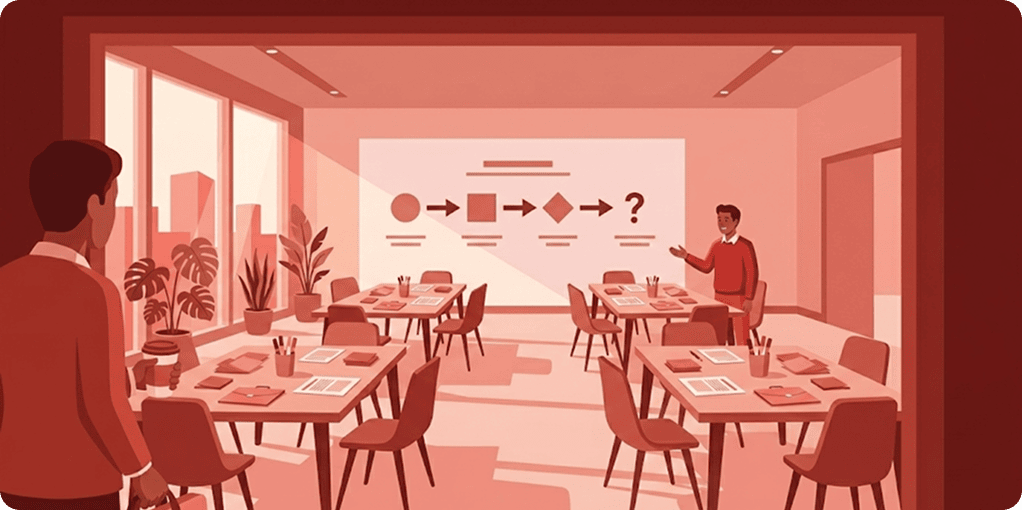
This chapter is written for executives, managers, and decision-makers who participate in workshops but don't facilitate them. Share it with your stakeholders before the session.
What to Expect
Someone on your team has proposed a workshop. You might be skeptical — you've sat through bad ones before. Meetings that produced sticky notes and warm feelings but no decisions. Sessions where you could have made the call in 15 minutes but instead spent 4 hours listening to people brainstorm.
A well-run workshop is different from that. Here's what to expect:
- It will be structured. There's a designed agenda with timed activities. You're not going to sit in a circle and share feelings. You're going to work through a sequence of activities designed to surface information, generate options, and converge on decisions.
- It will be time-bound. Good facilitators respect your time. There's a start time, an end time, and breaks in between. If the facilitator tells you it's 4 hours, it will be 4 hours.
- It will produce a tangible output. Before the workshop, you should receive a clear objective: "By the end, we will have [specific deliverable]." If you don't receive this, ask for it. No objective, no workshop.
- You'll be asked to participate actively. This isn't a presentation you observe. You'll write on sticky notes, vote on priorities, sketch ideas, and discuss tradeoffs. Your expertise and perspective are why you're in the room.
How to Be a Great Workshop Participant
- Come prepared. Review any pre-read materials. If you were asked to think about specific questions, actually think about them. Arriving prepared shows respect for the process and the other participants.
- Put your phone away. Not on the table. Not on vibrate. Away. If you're checking email during an activity, you're not contributing, and the people around you notice.
- Share your real opinion, not your safe opinion. Workshops work because they surface the thinking that doesn't come out in regular meetings. If you disagree with something, say so. If you see a risk nobody's mentioned, raise it.
- Listen more than you speak. Especially if you're the most senior person in the room. Your title carries gravitational pull — when you speak, people adjust their thinking toward yours. Hold your opinion until others have shared theirs. You'll hear things you wouldn't have heard if you'd spoken first.
- Trust the process. Some activities might feel silly or slow. Do them anyway. The warm-up that feels like a waste of time is actually calibrating the room's energy. The silent writing that feels awkward is preventing the loudest person from dominating.
Your Role as Decision-Maker
If you're in the room because you have decision-making authority, you have a specific and important role:
Before the workshop: Communicate to the facilitator what constraints are non-negotiable. Budget limits, timeline requirements, strategic direction — share these upfront so the workshop doesn't generate ideas that were never possible.
During the workshop: Participate as an equal. Don't override the group's process. If the group is heading toward a direction you know won't work, frame it as a constraint:
At the end: Make the decision clear. If the group has converged on a direction and you agree, say so explicitly: "I'm endorsing this direction. Let's move forward." If you need more time, say that too: "I'm taking this away. I'll make the final call by Friday and share my reasoning." The worst thing you can do is leave the room ambiguous — people won't know if the workshop's decisions will hold.
How to Evaluate Whether a Workshop Was Successful
Ask yourself three questions within a week of the workshop:
- Do I know exactly what we decided and why? If yes, the workshop achieved clarity. If you're fuzzy on the decision, the synthesis was weak.
- Am I confident the right people were heard? If the quiet expert's insight shaped the outcome, the facilitation worked. If the loudest voice won by default, it didn't.
- Is the team moving faster this week than they were before? If the workshop resolved a block, you'll see momentum. If people are still having the same debates, something wasn't resolved.
Part 5 · Stories from the Field
Real stories from real facilitators
Names changed, lessons preserved.
The CEO Who Wouldn't Stop Talking
James, the CEO of a 20-person design firm, decided to facilitate his first company workshop on "designing our future services." He'd read the books, planned carefully, even hired a consultant to observe.
Thirty minutes in, he didn't stop talking. The issue wasn't that he was a bad speaker. It was that he had so much context, so many opinions, so many stories about past projects that every prompt became a platform for him to think out loud. "What should our next service be?" turned into a 12-minute monologue about why the previous service had failed. Hands that had gone up stayed down. By hour two, his best designer wasn't looking at him anymore. She was checking her phone.
At the break, the observing consultant pulled James aside: "Your team has brilliant ideas. But they won't share them when you're explaining why you already thought of them."
James realized something hard: his authority actually suppressed thinking, not enhanced it. The second half of the workshop was different. When someone offered an idea, James asked a question instead of adding his own thought. When silence happened, he let it sit instead of filling it with his voice. He still spoke — the CEO's perspective matters — but he spoke less, and he spoke last instead of first.
The second half generated twice as many ideas as the first. Three months later, James's team was implementing changes they'd decided on together, not changes James had decided on and announced. The pace was faster. The commitment was deeper.
The lessonYour authority is most powerful when you exercise restraint. You don't need to be the smartest voice in the room. You need to be the voice that makes other voices feel safe.
The Accidental Icebreaker
The workshop started at 9 AM in a hotel conference room in Denver. Fifteen people from a healthcare startup, gathered to ideate on patient experience. Twenty minutes in, the fire alarm went off. Not a drill. An actual evacuation.
Everyone shuffled to the parking lot in the Colorado cold. People were annoyed. The workshop was already behind schedule. The facilitator, Keisha, felt her careful agenda dissolving.
Outside, waiting to re-enter the building, something unexpected happened. People started talking in ways they hadn't in the conference room. The forced proximity, the absurdity of being evacuated, the shared frustration — it loosened something. The VP of operations started joking with a junior designer. Two people who worked in different departments discovered they both had family in the same hometown. The energy became genuinely human instead of professionally cordial.
Twenty minutes later, they were allowed back inside. Keisha made a decision: instead of jumping back into the formal warm-up she'd planned, she asked everyone to share one thing they learned about a colleague in the parking lot. People laughed and volunteered stories. The room felt loose, connected, present in a way that an actual icebreaker might have taken 45 minutes to establish.
The best ideas of the day came from the conversations between the junior designer and the VP of operations — people who probably wouldn't have actually listened to each other in the normal hierarchy.
The lessonSometimes the best moments in a workshop are the ones you don't plan. Let people connect as humans first, and professionals second.
The Post-It That Changed Everything
The product team at a B2B invoicing software company had spent two hours mapping out a new feature: smarter duplicate detection. It was solid. It was technically sound. It would save customers 20 minutes per month.
Then someone on the team, a relatively quiet customer success manager, put a post-it on the wall: "But what if customers didn't have duplicates in the first place?"
The room went quiet. It was such a simple question, but it reframed the entire conversation. The team had been thinking about solving a symptom. This one post-it suggested solving the root cause.
Twenty minutes later, they'd pivoted entirely. Instead of building duplicate detection, they started scoping a data quality assistant that would help customers import cleaner data from day one. Six months later, this feature became their highest-adoption feature ever. One customer told their sales rep: "This saved us more time than any other feature you've built."
All because someone in the room — someone without formal authority, someone who usually stayed quiet — had the courage to question the direction everyone else was moving in.
The lessonQuiet people often have the best observations. They're listening while others are talking. But they only speak if they feel genuinely safe. Creating that safety is the facilitator's real job.
The Follow-Up That Mattered
A design team held a workshop on accessibility. The energy was great. The ideas were good. Everyone left convinced that accessible design mattered. Two weeks later, no one had done anything differently.
Then their facilitator did something most facilitators don't do. She sent a personal message to each participant: "I've been thinking about the workshop. I wrote down one thing each of you said that stuck with me. I want to check in: are you still thinking about that thing? Do you need help making it real?"
People responded. One person said they wanted to add accessibility checks to their design process but didn't know how. The facilitator sent a template. Another said they wanted to champion accessibility in their next project but needed cover from leadership. The facilitator connected them with the VP.
Two months later, the team had measurably shifted their accessibility practices. The workshop didn't make the change. The follow-up made the change. The workshop created the opening. The follow-up walked through it.
The lessonMost facilitators see their job as ending when people leave the room. The best facilitators know their job is just beginning.
My Worst Workshop Ever
This is a first-person account from a facilitator named Rachel:
"I was supposed to facilitate a product strategy workshop for a company I'd done good work with before. Twelve people. Six hours. Clear goal: align on market positioning for a new product line. I prepared meticulously. I had activities planned. I had backup activities if things moved fast. I was ready.
Then I walked in and everything fell apart. Half the room was jet-lagged. Two people were in conflict about something that happened the previous day, and their tension was poisoning the room. The CEO was checked out — on his laptop, barely present. And worst of all, I discovered 20 minutes in that my main activity relied on information the team didn't have yet. It was unusable.
I panicked. I tried to keep going with my backup activities. But the room could feel my fear. People checked out more. By hour three, we hadn't made any progress. By hour six, I'd failed. We didn't reach alignment. People left confused. I left devastated.
I sat in my car after and cried. Not because I was sad, but because I realized something: I'd spent so much time on my plan that I didn't spend time reading the room. The jet lag was visible from the moment people walked in. I could have acknowledged it: 'I see people are tired. Let's adjust.' Instead, I plowed forward with a 6-hour agenda designed for fresh people. The conflict between those two people was there in their body language. I could have named it. The CEO being checked out was a signal I should pause and ask: 'Is this the right time for this workshop?' Instead, I kept performing.
So what did I do differently next time? I showed up early. I started the workshop by naming what I was noticing: 'I can see some people are tired. Let's go with short bursts instead of long blocks.' I gave the CEO permission to step out if he needed to. And I built in explicit pause points where I could read the room and adjust. I didn't stick to my plan religiously. I watched people, and I changed based on what I was seeing.
That second workshop was different. Still not perfect. But better."
The lessonA facilitator's job isn't to execute a plan. It's to hold space for a group of humans to do their best thinking. Sometimes that means abandoning the plan entirely.
Your Impact Journey Starts Now
You've read through frameworks, formulas, case studies, and stories. You have the measurement model, the business case template, and the scaling playbook. You're more equipped than most people who've been facilitating for years.
But here's the truth: reading about workshop impact doesn't create it. Running workshops creates it. Measuring them creates it. Following up creates it. Scaling the practice to your team and your organization creates it.
- Start this week. Pick one workshop you've already run (or plan to run) and apply the 4-Level Measurement Model. Even measuring at Levels 1 and 2 puts you ahead of 90% of facilitators.
- Start tracking. Create the simple ROI spreadsheet from Chapter 3. One row per workshop. After 5 workshops, you'll have enough data to make the case to anyone.
- Start sharing. Send the Stakeholder's Guide to the next executive who'll participate in your workshop. Share a case study with a skeptical colleague. Use the pitch email template to propose your next session.
- Start scaling. Identify one person on your team who'd make a good facilitator. Invite them to observe your next workshop. Start the "See One, Do One, Teach One" cycle.
The organizations that thrive aren't the ones with the best individual contributors. They're the ones that think together better than their competitors. Workshops are how you build that capability — one session, one decision, one follow-up at a time.
Go make impact.
Back matter
The Workshopr Facilitation Series
This is Book 3 of 6 in The Workshopr Facilitation Series.
The Series
Run Your First Design Workshop in 72 Hours
A day-by-day sprint plan for your first workshop. 7 chapters.
Facilitating With Intention
The mindsets, methods, and moves that separate good facilitators from great ones. 7 chapters.
Did It Work? — you are here
Measuring workshop impact when half of it can't be put on a slide. 8 chapters.
They'll Never Say Yes
Selling internal workshops to leaders who think they don't have time. 6 chapters.
Get Out of the Car
On running rooms where you're not the most senior, the most expert, or the most expected. 8 chapters.
The Synthesis Playbook
AI-assisted recipes for turning workshop outputs into defensible decisions. 12 chapters.