Workshop Facilitation Series — The crisis-mode sprint plan

You've got 72:00:00
to run a design workshop.

Day 0 · Monday, 9 AM

The clock on the wall blinks 9 a.m. Monday. By Thursday the room will be full, everyone looking at you. There's a fresh Google Doc, an empty whiteboard, and sticky notes still inside their wrappers. This book is your sprint plan — and the sprint has already begun.

arrow_downwardScroll — one day per chapter
4 daysFrom "no idea" to "it actually worked"
5–8Participants — the sweet spot for generative work
80%Of available time you plan. The rest absorbs reality.
24hWindow to send the follow-up before work disappears

The Manual — Everything in the book

One chapter per day. Exactly what to do, and the words to say out loud.

01

Today

Define & Scope

Today is about making four decisions. Get this right, and the rest falls into place.

target

The objective formula

One concrete statement that tells participants exactly what they'll walk out with. The ending must be a tangible output, not a feeling — could you hold it in your hands?

"By the end of this workshop, we will have [a prioritized list of the top 5 problems our customers face during onboarding]."
domain

Choose the format

In-person for high-stakes decisions and fast iteration. Remote for distributed teams and shorter sessions. Hybrid? Best for almost nothing, honestly — if you must, assign a dedicated remote advocate.

schedule

Decide duration

Half-day for one narrow objective. Full-day is the sweet spot for most design workshops. Start shorter than you think you need — you can't get back the goodwill you lose trapping people for a day.

groups

Build the participant list

Who you invite matters more than what activities you choose. A decision-maker, the people closest to the problem, a customer voice, one challenger. Exclude observers — send them the summary.

send

Send the pre-workshop brief

Fill in the brackets and send as-is: objective, why it matters, each person's role, and 15 minutes of pre-work. Template included with the book.
02

Tomorrow

Design Your Agenda

Most first-timers overthink (seven activities when three would do) or underthink (a vague plan and hope). The 5-part agenda removes the guesswork: Opening → Warm-Up → Core Activities → Synthesis → Close. Works for a 90-minute session and a two-day sprint alike.

monitoring

Ride the energy arc

Late morning is your golden window — put the deepest thinking there. Right after lunch, run something physical: gallery walks, dot voting, anything that gets people out of chairs.

timer

Time-box honestly

New facilitators consistently underestimate. Silent brainstorming: 5–8 min before quality drops. Affinity mapping: always takes longer than you think. Decision discussion: set a hard stop or it expands indefinitely.

local_fire_department

Never skip the warm-up

It feels like wasted time on a packed agenda. Skip it and you'll spend the first forty minutes of "real work" getting what a warm-up gives you in ten.

One-Word Check-In (5 min): "Share one word — just one — that describes how you're feeling right now. No wrong answers. I'll go first."
dashboard_customize

Pre-built agenda templates

Discovery (stakeholder map → journey mapping → How Might We) and Prioritization (impact/effort matrix → dot voting → MoSCoW). Ideation and Critique agendas ship with the companion files.

03

The day before

Setup & Prepare

A well-prepared space tells participants, "this is going to be different from a regular meeting." A poorly prepared one tells them you didn't think it through.

table_restaurant

The Pod Layout

Four to six tables in small clusters, four to six people each. A central whiteboard serves as focal point, but the real action is distributed across the pods. The facilitator floats.

inventory_2

Materials checklist

Sticky notes (4 colors, 2 pads each), chisel-tip markers for everyone, dot stickers, a visible timer, printed agendas, and a camera for photographing outputs. 25+ items in the full checklist.

cast

Remote tooling

Three things: a video call, a shared canvas, a timer. Pre-build the Miro/FigJam board, add a sandbox area for warm-up practice, lock the frames you don't want moved — and keep a Google Doc as backup.

medical_information

Your facilitation kit

One document: the timed agenda with transition notes, word-for-word activity instructions, a backup plan per activity, probe questions for stalls, and participant names so you can call on people.

Probe for a stalled room: "What would our biggest competitor do here?" / "What are we afraid to say out loud?"
04

Workshop day

Facilitate

You're standing in front of a group of people, waiting. Fifteen years in, the adrenaline never fully goes away — but a script for the first fifteen minutes makes it work for you instead of against you.

play_circle

The first 15 minutes, scripted

Minutes 0–3 welcome and human moment · 3–7 context and objective · 7–10 agenda overview · 10–15 ground rules: phones away, one conversation at a time, "yes, and", timebox respect.

"Before we get into the work, let's just take a second to arrive. If you're still thinking about that email, write yourself a one-line note, put your phone away, and let's be fully here for the next [X hours]."
front_hand

Time management

A visible timer for every activity. A parking lot for important-but-off-topic points. And mark one activity as "cuttable" before you start — if you run behind, that's the one you drop.

psychology

Manage the personas

The Silent One (structure, not spotlight). The Dominator (30 seconds each, around the room). The Naysayer (capture the risk — skeptics become allies). The Side-Talker (walk toward it).

Core technique
Time
What it does
Dot Voting
10–15 min
Surfaces the group's priorities from a large set of options. 3–5 dots each, no talking during voting.
Affinity Mapping
20–30 min
Organizes a wall of individual ideas into themes via 10 minutes of silent sorting, then naming clusters.
Crazy 8s
~10 min
Eight panels, eight minutes, one idea per minute. Speed over quality — first thought, best thought.
How Might We
15–20 min
Reframes pain points as design opportunities: "Users abandon checkout" → "How might we make shipping costs feel fair?"
photo_camera

Synthesis: turning sticky notes into outcomes

A wall full of sticky notes isn't an outcome. In the last 30 minutes: walk the group through the wall, write each decision on a fresh note, ask "who owns this, what's the next step, by when?" — and photograph everything before anyone touches the wall.

The sample full-day agenda — drag through the day.

Included as a fill-in template: every slot has a time, a duration, and a purpose. Notice the energizer right after lunch and the break rhythm — never more than 75 minutes without one.

9:0015m
Arrival & coffee

Settle in

9:1515m
Opening

Context, objective, ground rules

9:3015m
Warm-up: Hopes & Fears

Get people talking

9:4545m
Core 1: Discovery

Frame the problem

10:3015m
Break

Recharge

10:4560m
Core 2: Deepest thinking

The most important work of the day

Peak energy window
11:4530m
Share-out & discussion

Align on findings

12:1545m
Lunch

Real break, no working lunch

13:0015m
Energizer

Physical & interactive — beat the dip

13:1545m
Core 3: Ideation

Create options

14:0025m
Gallery walk + dot voting

Surface top ideas

14:2510m
Break

Recharge

14:3540m
Core 4: Prioritization

Converge on decisions

15:1520m
Synthesis

Capture decisions & outputs

15:3515m
Next steps round

Assign ownership

15:5010m
One-word close

End strong — "energized" means you did your job

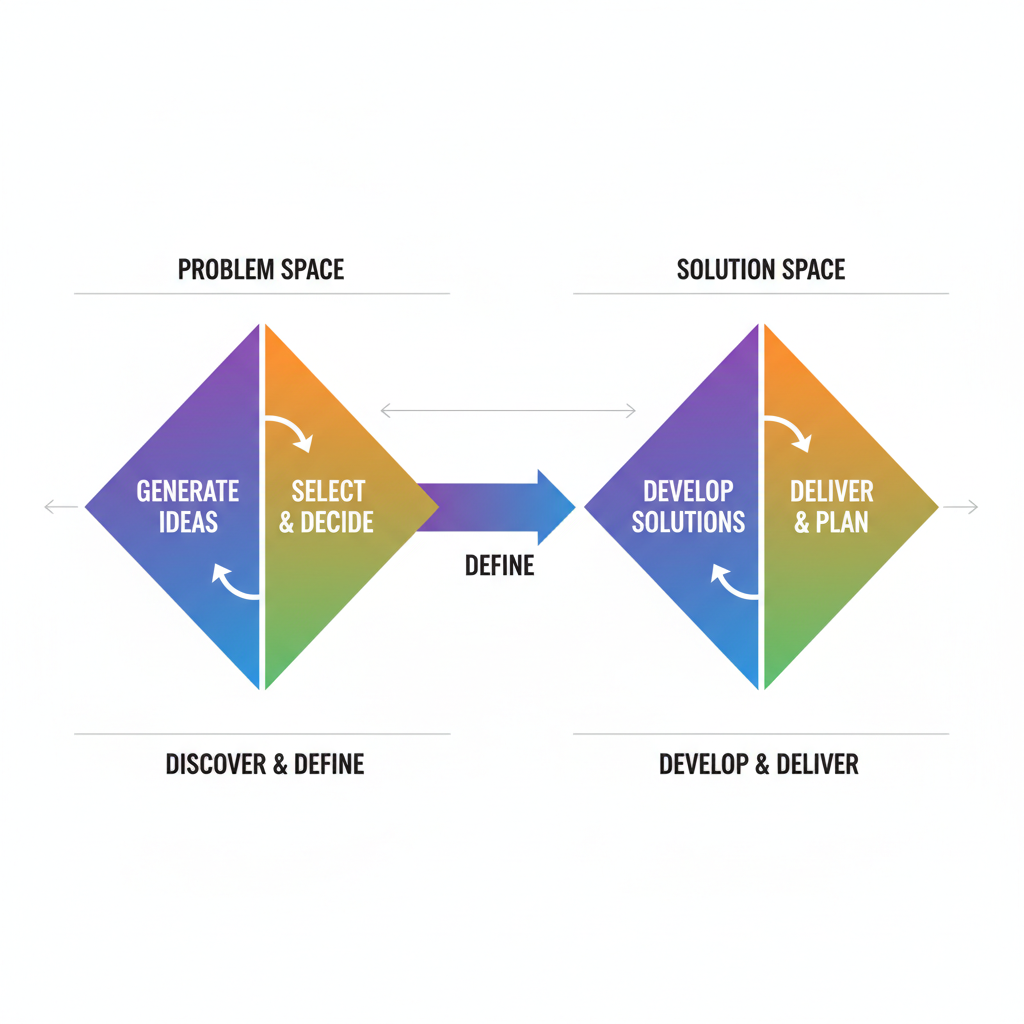
Double-diamond diagram: discover and define in the problem space, develop and deliver in the solution space

Every workshop alternates between two modes. The most common mistake is converging too early.

open_in_full

Diverge

Generate options, expand thinking, welcome wild ideas. Don't evaluate or critique.

Tools: brainstorming · Crazy 8s · How Might We
close_fullscreen

Converge

Narrow down, apply criteria, vote, debate, and commit to a direction.

Tools: dot voting · impact/effort matrix · structured discussion
campaign

Signal the shifts out loud

"We've been in expansion mode for the last hour. Now we're going to shift to decision mode." If the group jumps to judging during a brainstorm, gently redirect.

Before & after the room

Get the yes. Then make it stick. Both emails are written for you.

Get buy-in fast

Subject: Design Workshop — [Topic] — [Date]

Why now: We need a decision on [topic]. The right answer depends on input from multiple disciplines.

What we'll deliver: A documented decision, the reasoning behind it, and next steps with owners.

Why this matters: If we decide without alignment, we risk rework down the line. This workshop ensures we move together.

Send within 24 hours

Subject: [Workshop Name] — Summary and Next Steps

Key decisions: [Decision 1] · [Decision 2] · [Decision 3]

Action items: each with an owner and a deadline.

Full documentation: [link] — "If anything in this summary doesn't match your understanding, please reply. I'll check in on progress in about one week."

Book 1 cover: Run Your First Design Workshop in 72 Hours

Get the book — free.

The full PDF plus every companion file: the pre-workshop brief, the follow-up template, the 25+ item materials checklist, the complete agenda set, and the 12 Intervention Cards. Straight to your inbox.

That doesn't look like an email address — give it another go.

No spam. One email with the files, plus the occasional facilitation tip. Unsubscribe anytime.

mark_email_readCheck your inbox — Book 1 and the companion files are on their way.

Book 2 cover: Hold the Room Book 1 cover: Run Your First Design Workshop in 72 Hours Book 3 cover: Did It Work?