Workshop Facilitation Series — The measurement & scaling guide

You know workshops work.
Now prove it.

Book 3 · For making the case

You've seen teams align in hours instead of weeks. You've watched decisions stick. But knowing workshops work and proving it are two different things. This isn't philosophy. It's the business case for thinking together — backed by frameworks you can use starting this week.

arrow_downwardScroll — prove it, then scale it
925%Net ROI of the half-day discovery workshop in the worked example
4Measurement levels — from instant reactions to business results
80%+Decision durability at 8 weeks — the mark of real alignment, not false consensus
48hThe window that converts workshop energy into real-world momentum

The Guide — Everything in the book

Workshops aren't just good process. They're good business.

01

Part 1 · Proving value

The Real ROI of Workshops

"We don't have time." "Can't the design team figure this out?" "What's the ROI?" These are real objections from real stakeholders — and if you argue from "this feels right" while they argue from "this costs money and time," you'll lose.

handshake

The unsexy truth: alignment beats decision quality

Three weeks crafting a proposal, presented to an uncertain room, doubts surfacing two weeks into execution — worse outcomes and wasted time. The alternative: two hours in a room thinking together, disagreements hashed out in real time, actual alignment when you walk out.

The pitch: "Rather than me making a recommendation in a vacuum and having us iterate on it three times, let's spend [X hours] getting the key people in a room thinking together. That saves us [timeline] and reduces the risk of building something that doesn't work."
schedule

"We don't have time."

Reframe it — then show the math.

Say this: "Without alignment, I estimate two rounds of revisions — about 20 hours across the team. This workshop is 4 hours total. We come out ahead by 16 hours."
verified

"How will we measure success?"

A great question with a concrete answer.

Say this: "We'll know it worked if everyone can articulate the decision and why, if we launch without a major pivot, and if the team implements with momentum instead of uncertainty."
cases

Case study: the junior designer vs. the VP who hated workshops

Dani didn't sell "collaboration." She quantified three features that needed rework (~340 engineering hours), then pitched a 3-hour structured decision session as business efficiency. Richard replied in four minutes: "Tuesday works. Keep it tight." By Q4, he was requesting workshops himself.
02

Part 1 · Measurement

The 4-Level Measurement Model

If you can't answer "did it work?" with something more specific than "people seemed engaged," you'll never build a sustainable case. Adapted from Kirkpatrick's evaluation framework: four progressively deeper levels. Most teams stop at Level 1. The teams that prove ROI measure at Levels 3 and 4.

Level
When
What you're measuring
1 · Reaction
0–24 hours
Did participants find it valuable? One-word close + 3-question survey. Target: 4.0+/5 satisfaction. A hygiene check, not a success metric.
2 · Learning
0–48 hours
Did understanding improve? Decision clarity check + assumption alignment test. Target: 90%+ articulate the same decision.
3 · Behavior
2–8 weeks
Did work practices change? Action item completion, decision durability, fewer follow-up meetings. Target: 80%+ completion, 80%+ durability.
4 · Results
3–6 months
Did business outcomes improve? Time-to-market, rework reduction, meeting reduction, customer metrics. Target: 40–60% less rework.
scoreboard

The Workshop Impact Scorecard

One template, every workshop: 10 minutes to fill out immediately after, 5 minutes per checkpoint. Track it across workshops and you build a dataset that makes the case for you. After 5–10 workshops, the patterns become clear.

03

Part 1 · The math

Making the Business Case

Executives don't fund feelings. They fund returns. The cost formula, the value formula, and three worked examples you can adapt for your own organization.

payments

The cost formula

Be honest about it — it builds credibility. A full-day workshop with 8 participants: $4,200 in participant time + $900 facilitation + $200 materials = $5,300. Sounds like a lot, until you compare it to what it prevents.

trending_up

The value formula

Value comes from three sources: decisions accelerated (scattered decision-hours avoided × hourly rate), rework prevented (probability × average cost), and alignment gained (meeting-hours eliminated × weeks × people × rate).

Worked example
Net ROI
How
Half-day discovery
925%
$2,400 cost → $24,600 value. Decision in 1 day instead of 3 weeks; rework risk cut from 40% to 10%.
Full-day prioritization
547%
$7,500 cost → $48,500 value. One revision cycle instead of four; launch delay cut from 4 weeks to 0–1.
2-day design sprint
329%
$12,750 cost → $54,750 value. User feedback in 5 days instead of 8 weeks; $42,000 of wasted engineering prevented.
request_quote

The one-page business case template + ROI tracker

The problem, the cost of inaction, the proposed workshop, expected value, and the measurement plan — on one page. Then track every workshop in a simple spreadsheet. One workshop's ROI is an anecdote. Ten workshops' ROI is a trend. That's not a feeling. That's a business case.

04

Part 2 · After the workshop

Converting Energy into Action

The workshop ended an hour ago. The energy is fading and the sticky notes are starting to curl. What you do in the next 48 hours determines whether it generates lasting impact or becomes a pleasant memory that changes nothing.

checklist

The 24-hour documentation checklist

Photograph everything, transfer sticky notes to a digital document, write decisions in the exact language agreed in the room, list action items with owners and deadlines, capture the parking lot, archive the boards.

summarize

The scannable output document

Six sections: summary, key decisions, insights and themes, action items (with a status column you update weekly), parking lot, photos and artifacts. Scannable — not a wall of text.

monitor_heart

Case study: the workshop that almost died on Monday

A brilliant two-day hospital workshop, a thorough Monday-morning summary email — and zero replies by Wednesday. Elena rescued it with three moves: personal follow-ups instead of group emails (unblock, don't nag), a 30-minute peer checkpoint two weeks out, and a visible progress tracker sent to the whole group. Six weeks later, every initial action item was done.

The client's verdict: "The workshop gave us the direction. But your follow-up is what made it real. This time was different because you didn't let us forget."
rate_review

Measure success at three horizons

Immediate (48h): did you produce the tangible output? Short-term (2 weeks): action items completed, decisions held. Long-term (1–3 months): did the output influence the final direction? Track it in a one-row-per-workshop spreadsheet — patterns emerge fast.

05

Part 3 · Scaling

Scaling Facilitation in Your Org

Running a great workshop is a skill. Building an organization where workshops are the default way decisions get made is a transformation — from "one person who runs workshops" to "an organization that thinks together."

Maturity stage
Who facilitates
What to do next
1 · Individual
1–2 people
One hero facilitator; workshops stop when they're busy. Next: document your process and templates.
2 · Team
3–5 people
A small group facilitates competently. Next: start a co-facilitation program and share results across teams.
3 · Organizational
10+ people
Workshops embedded in process; leadership requests them. Next: a community of practice + org-level ROI measurement.
4 · Cultural
Everyone
The org doesn't "do workshops" — it thinks together by default. Next: maintain, evolve, share externally.
school

See One, Do One, Teach One

Borrowed from medical training: observe with a specific guide, run one with backup in the room, then mentor someone new. In 8–12 weeks you can develop a facilitator from "never done this" to "runs solid sessions independently."

block

When NOT to run a workshop

The decision's already made. One person has all the information. The topic is purely informational. There's no decision-maker in the room. The group is 15+ without breakouts. Trust is too low for honesty. Knowing when not to facilitate is as important as knowing how.

06

Part 3 · Share this one

The Stakeholder's Guide

Written for executives, managers, and decision-makers who participate in workshops but don't facilitate them. Share it with your stakeholders before the session.

fact_check

What to expect

It will be structured, time-bound, and produce a tangible output — and you'll be asked to participate actively. No objective, no workshop.

diversity_3

How to be a great participant

Come prepared. Put your phone away. Share your real opinion, not your safe one. Listen more than you speak — especially if you're the most senior person in the room. Trust the process.

gavel

Your role as decision-maker

Before: share non-negotiable constraints upfront. During: participate as an equal — frame concerns as constraints, not vetoes. At the end: make the decision clear.

Say this: "I'm endorsing this direction. Let's move forward." — or — "I'm taking this away. I'll make the final call by Friday and share my reasoning." The worst thing you can do is leave the room ambiguous.

Stories from the field — names changed, lessons preserved.

Part 5 closes the book with real stories from real facilitators: the wins, the rescues, and the worst workshop ever. Drag to browse.

Story 01

The CEO Who Wouldn't Stop Talking

James facilitated his own company's workshop — and monologued through hour one. After the break he asked questions instead of adding thoughts, spoke less, and spoke last. The second half generated twice as many ideas.

Your authority is most powerful when you exercise restraint. Be the voice that makes other voices feel safe.

Story 02

The Accidental Icebreaker

Twenty minutes in, a real fire alarm evacuated the room into the Colorado cold. In the parking lot, people connected as humans. Keisha scrapped her formal warm-up and built on it instead.

Sometimes the best moments in a workshop are the ones you don't plan.

Story 03

The Post-It That Changed Everything

Two hours into mapping duplicate detection, a quiet customer success manager posted: "What if customers didn't have duplicates in the first place?" The team pivoted — and shipped their highest-adoption feature ever.

Quiet people often have the best observations. Creating the safety for them to speak is the facilitator's real job.

Story 04

The Follow-Up That Mattered

Great accessibility workshop, zero behavior change — until the facilitator sent each participant a personal note: "I wrote down one thing you said that stuck with me. Do you need help making it real?"

The workshop created the opening. The follow-up walked through it.

Story 05

My Worst Workshop Ever

Jet-lagged room, simmering conflict, a checked-out CEO, and a main activity that turned out to be unusable. Rachel plowed forward with the plan anyway — and failed. The lesson reshaped how she facilitates.

A facilitator's job isn't to execute a plan. It's to hold space for a group of humans to do their best thinking.

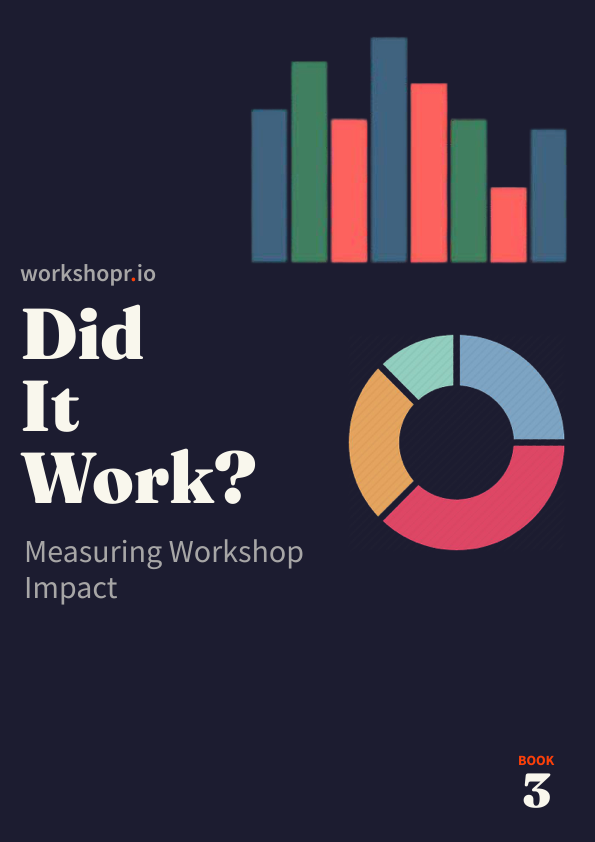
Book 3 cover: Did It Work? Measuring Workshop Impact

Get the book — free.

The full PDF of Did It Work?: the 4-Level Measurement Model, the cost and value formulas with three worked examples, the Workshop Impact Scorecard, the one-page business case template, the scaling playbook, and the Stakeholder's Guide. Straight to your inbox.

That doesn't look like an email address — give it another go.

No spam. One email with the files, plus the occasional facilitation tip. Unsubscribe anytime.

mark_email_readCheck your inbox — Book 3 is on its way.

Book 2 cover: Facilitating With Intention Book 3 cover: Did It Work? Book 1 cover: Run Your First Design Workshop in 72 Hours