Workshop Facilitation Series — Scripts to get your workshop approved

They'll never
say yes.

Book 4 · The buy-in playbook

You already know the workshop will work. You've designed the agenda. The problem isn't the workshop — it's getting someone with calendar authority to say yes. Word-for-word scripts for the five objections you'll hear most, with follow-up lines for when they push back.

arrow_downwardScroll — five objections, five scripts
5Objections that cover 90% of the resistance you'll encounter
1Stakeholder email that's landed a yes from startups to Fortune 500s
60sThe compressed hallway pitch, for when that's all you get
2ndThe second ask almost always gets a yes — if you documented the first

Chapter 2 — The framing that works

Every objection to a workshop is really an objection about time. Your job is to flip that equation.

"We're at a decision point with multiple valid perspectives. Right now we're making that decision through Slack threads and it's been six weeks without resolution. I'm proposing we spend 2–3 hours getting everyone in one room to surface the disagreements, work through them with a structured process, and walk out with a decision that everyone helped shape. That's 2–3 hours versus the weeks we've already spent going in circles."

WHY IT LANDS · 01

It quantifies the cost of inaction. "It's been six weeks" is harder to dismiss than "we should do a workshop."

WHY IT LANDS · 02

It names the dysfunction without blaming anyone. You're describing a pattern, not pointing fingers.

WHY IT LANDS · 03

It makes the workshop sound like the efficient option. Because it is.

The five objections — word for word

You've heard these before. Now watch them lose.

A few rules first: don't memorize these word for word — internalize the logic so you can adapt in a hallway, on Slack, or when someone pushes back unexpectedly. Lead with listening. And take one objection at a time: answering everything at once sounds defensive, addressing one thing sounds confident.

01

Objection one

Why it worksYou're not asking for more time. You're offering to compress the time they've already been wasting.

The stakeholder"We don't have time for a workshop."
Say this"I hear you, everyone's stretched. But let's look at what we've already spent on this. There have been [number] meetings about [topic] over the past [timeframe], plus the Slack threads and the async back-and-forth. If we add that up, we've already spent more time than a focused two-hour session would take. The difference is that those hours didn't produce a decision. This one will."
If they push back"I can design a 90-minute version. Tight, structured, no filler. We walk in with a clear objective, work through it, and walk out with a decision. Ninety minutes to close something that's been open for [timeframe]. That's a net time savings."
02

Objection two

Why it worksYou've acknowledged the value of the survey while making clear what it can't do — and turned their objection into part of your plan.

The stakeholder"Just send a survey."
Say this"A survey will tell us what people prefer individually. But the decision we need to make here depends on trade-offs that require conversation. [Person A] needs X, [Person B] needs Y, and those might conflict. A survey won't surface that tension — it'll just give us two contradictory data points. The workshop is designed to get those two perspectives in the same room so we can find the path that works for both."
If they push back"Tell you what — I'll send a short pre-read survey to collect individual perspectives before the workshop. That way we walk in with the data, and the workshop is focused on the conversation the survey can't have."
03

Objection three

Why it worksYou've repositioned the workshop from "everyone does design" to "the design team gets the input they need to do their job well."

The stakeholder"The design team can figure this out."
Say this"The design team absolutely can figure out the design. What we can't figure out alone is the business constraints, the technical trade-offs, and the stakeholder priorities that should shape the design. If we design in isolation and then present it, we'll get feedback that sends us back to the drawing board. I've seen that cycle take three rounds. The workshop collapses those three rounds into one session by getting the constraints on the table before we design, not after."
If they push back"I'm not asking everyone to design. I'm asking the people with context — engineering, product, the business stakeholder — to spend two hours helping us frame the problem correctly. The design team will take it from there. But we'll be building on shared understanding instead of assumptions."
04

Objection four

Why it worksThe pulse check is your secret weapon. It almost always reveals that "we all agree" actually means "nobody has disagreed yet." Once you can show the divergence, the workshop sells itself.

The stakeholder"We know what we need to do."
Say this"That might be the case, and if it is, the workshop will be short. But in my experience, when I hear 'we already know,' it often means one or two people have a clear direction and the rest haven't been asked. If everyone truly agrees, we'll confirm it in thirty minutes and use the rest of the time to plan execution. If there are hidden disagreements, we'll surface them now instead of discovering them three weeks into implementation."
If they push back"Let me do a quick pulse check, three questions to five people. If everyone's genuinely aligned, I'll cancel the workshop. If there's any divergence, we run it. Fair?"
05

Objection five

Why it worksThe "straw man" approach gives the leader their recommendation while still creating the space for the group to shape the decision — and framing it as something to be improved, not defended, reduces the ego dynamics.

The senior leader"Can't you just make a recommendation?"
Say this"I can absolutely present a recommendation. But here's what happens next: you'll want input from [engineering / product / legal / whoever], they'll have questions I can't answer on their behalf, and we'll end up in a series of follow-up meetings. The recommendation becomes a starting point for debate rather than a decision. The workshop compresses that entire cycle into one session. Instead of me recommending and everyone reacting over two weeks, we co-create the answer in two hours."
If they push back"How about a hybrid approach? I'll prepare my recommendation and present it at the start of the session as a straw man. Then we use the structured workshop process to stress-test it, improve it, or replace it. Either way, we walk out with something stronger than what any one person could produce alone."
0:60hallway version

Only got a hallway? Here's the 60-second version.

If you only have a quick Slack message or a walk to the elevator, here's the compressed pitch:

Say this: "We've been going back and forth on [topic] for [timeframe]. I can design a [90-minute / 2-hour] session that gets [the key people] in a room with a structured process and walks out with a decision. It'll save us weeks of async back-and-forth. Can I send you the details?"

Short. Specific. Positions the workshop as the faster path, not the slower one.

The closer

The stakeholder email that lands the yes.

This email has landed a yes in startups, agencies, and Fortune 500 companies. Fill in the brackets. Adjust the tone for your organization. Send it.

check_circle

It names the cost of the status quo. Not in vague terms — in specific weeks, specific consequences.

check_circle

It asks for almost nothing. They don't need to prepare, design, or organize. They just need to show up.

check_circle

It's a proposal, not a permission slip. You're not asking "can I run a workshop?" You're saying "here's what I'm planning. Does Tuesday work?"

check_circle

It specifies the output. The recipient knows exactly what they'll get for their time investment.

When they still say no

  1. Document it. "Understood. I've noted that we're proceeding with [current approach] for [topic]. I'll document my workshop proposal in case we want to revisit it."
  2. Make your recommendation anyway. Through the channels they prefer. Don't sulk. Do the work.
  3. Wait for the opening. When the async approach fails or the decision gets revisited for the third time, don't say "I told you so." Say "I think we're at a good moment to try that working session I proposed. Want me to set it up?"

→ The second ask almost always gets a yes.

Template · the stakeholder email Subject: Proposal: [X]-hour working session on [topic][date]

Hi [name],
I want to propose a focused working session to resolve [specific decision/problem].

The situation: We've been working through [topic] for [timeframe]. There are [number] open questions that need input from multiple people, and the current approach — [Slack threads / async reviews / recurring meetings] — hasn't produced a clear resolution. I think we're stuck not because people disagree, but because we haven't had the right conversation yet.

What I'm proposing: A [duration]-hour structured session on [date] with [list of 5–8 people by name or role]. I'll design and facilitate the agenda. Participants don't need to prepare anything beyond a [5–10 minute pre-read I'll send in advance].

What we'll walk out with:
· A documented decision on [specific thing]
· The reasoning behind it, captured in writing
· A list of next steps with owners and deadlines

Why now: Every week this stays unresolved costs us [specific cost: delayed launch, rework risk, team confusion, blocked dependencies]. A [duration]-hour investment now prevents [specific consequence] later.

What I need from you: Confirmation that [date/time] works, or an alternative that does. I'll handle everything else.

Happy to talk through this if you have questions.
[Your name]
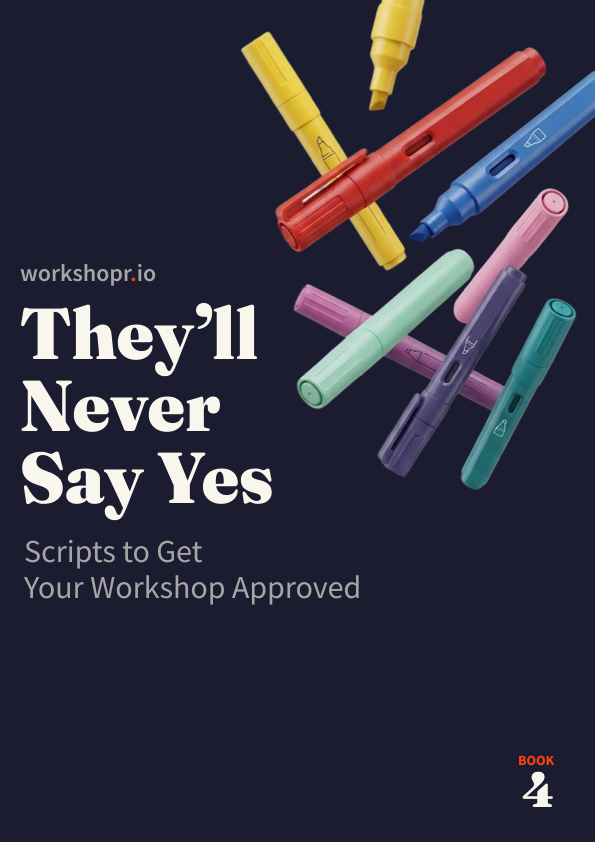
Book 4 cover: They'll Never Say Yes

Get the playbook — free.

The full PDF of They'll Never Say Yes: the foundational reframe, all five objection scripts with push-back follow-ups, the stakeholder email, the still-no strategy, and the 60-second hallway version. Straight to your inbox.

That doesn't look like an email address — give it another go.

No spam. One email with the files, plus the occasional facilitation tip. Unsubscribe anytime.

mark_email_readCheck your inbox — Book 4 is on its way.

Book 3 cover: Did It Work? Book 4 cover: They'll Never Say Yes Book 1 cover: Run Your First Design Workshop in 72 Hours