Foreword
About This Book
You already know the workshop will work. You've designed the agenda. You know who needs to be in the room. You can see exactly how two hours together will resolve what three weeks of Slack threads couldn't.
The problem isn't the workshop. It's getting someone with calendar authority to say yes.
This playbook is for that conversation. The one with the engineering director who thinks Slack is faster. The VP who wants a recommendation, not a working session. The stakeholder who says "we already know what we need to do," and means "I know what I want to do."
You'll get the foundational reframe that works across every objection — the one that flips the question from "why spend two hours?" to "why have we already spent six weeks?" You'll get word-for-word scripts for the five objections you'll hear most, with follow-up lines for when they push back. You'll get a stakeholder email that has landed a yes in start-ups, agencies, and Fortune 500 companies. And you'll get a strategy for the times they still say no, because sometimes the answer is no, and what you do next matters.
The hardest part of facilitation isn't the room. It's getting to the room.
Let's fix that.
Chapter One
Let's Set the Stage
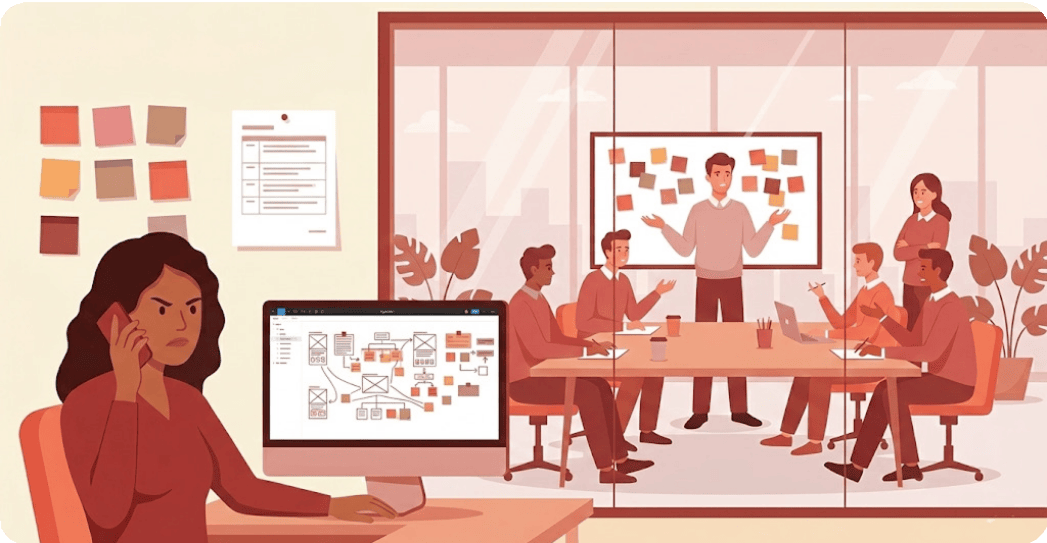
Years ago, a product designer I was coaching called me on a Friday afternoon. She'd just spent three weeks watching her team go in circles on a navigation redesign. Slack threads. Figma comments. A Google Doc with seventeen conflicting opinions. She knew a two-hour workshop would resolve it. She'd even designed the agenda.
Her problem wasn't the workshop. It was her engineering director, who'd said: "We don't have time to sit in a room for two hours when we could just make a decision in Slack."
Six weeks later, the team still hadn't made the decision in Slack.
This playbook exists because the hardest part of running a workshop isn't facilitating it. It's getting the people who control the calendar to say yes. I've heard every objection. I've lost some of those arguments and won most of them. The scripts in this playbook are the ones that won.
Chapter Two
The Framing That Works
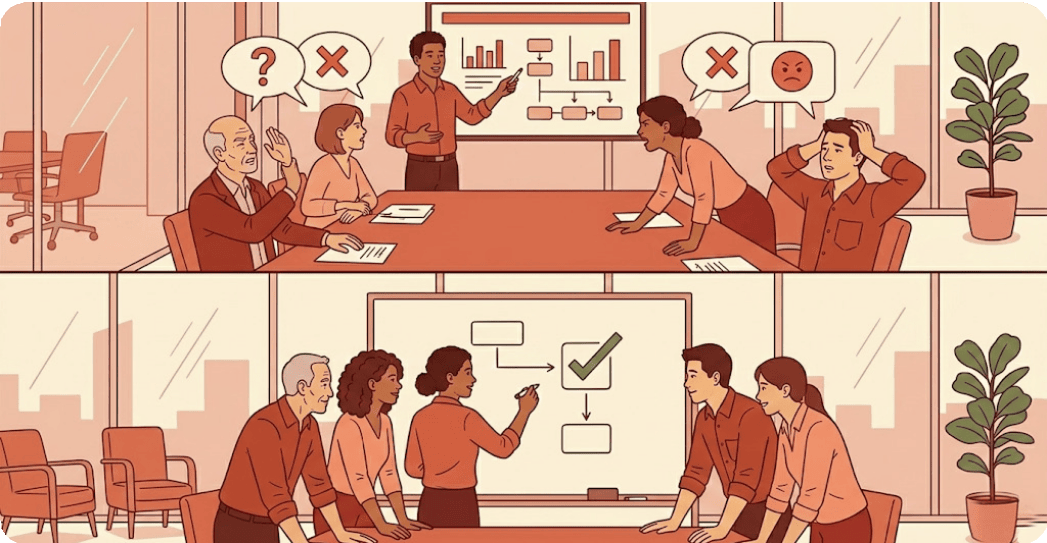
Before we get into specific objections, here's the foundational reframe. Every objection to a workshop is really an objection about time. The person saying no believes the workshop will cost more time than it saves. Your job is to flip that equation.
The core pitch (memorize this):
"We're at a decision point with multiple valid perspectives. Right now we're making that decision through [Slack threads / async comments / back-and-forth meetings] and it's been [X weeks] without resolution. I'm proposing we spend [2–3 hours] getting everyone in one room to surface the disagreements, work through them with a structured process, and walk out with a decision that everyone helped shape. That's [2–3 hours] versus the [weeks/months] we've already spent going in circles."
Three things make this pitch work:
- It quantifies the cost of inaction. "It's been six weeks" is harder to dismiss than "we should do a workshop."
- It names the current dysfunction without blaming anyone. You're describing a pattern, not pointing fingers.
- It makes the workshop sound like the efficient option. Because it is.
The five objections
Every objection to a workshop is a variation on the same fear: this will cost more than it's worth. The five below cover 90% of the resistance you'll encounter, from the time-pressed manager to the senior leader who just wants a recommendation. They all respond to the same move: show them the workshop is the faster path.
A few rules before you use these scripts:
- Don't memorize them word for word. These are frameworks. Internalize the logic so you can adapt in the moment, in a hallway, on Slack, in a meeting where someone pushes back unexpectedly.
- Lead with listening. Make sure you understand the real objection before you counter. "We don't have time" sometimes means the calendar is full. Sometimes it means "I don't trust this process."
- One objection at a time. Answering everything at once sounds defensive. Addressing one thing sounds confident.
- Know when to stop pushing. If someone is saying no for political reasons they won't name, no script will fix that. Read the room.
Objection 1
"We don't have time for a workshop."
This is the most common objection and the easiest to counter, because the person saying it is already spending more time on the problem than the workshop would take.
Why it worksYou're not asking for more time. You're offering to compress the time they've already been wasting.
Objection 2
"Just send a survey."
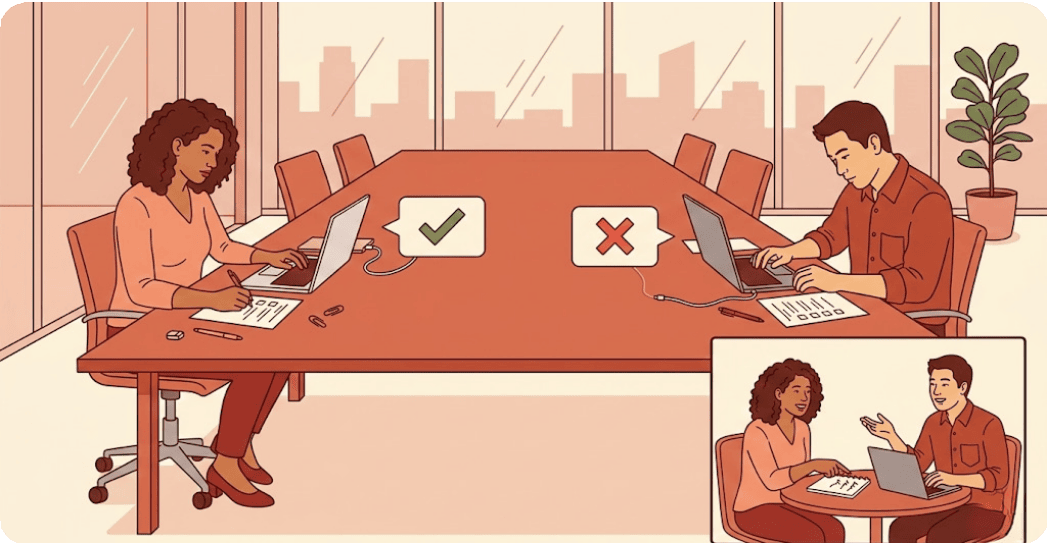
This one comes from people who think workshops are just a fancy way to collect opinions. They believe a Google Form can do the same thing.
Why it worksYou've acknowledged the value of the survey while making clear what it can't do. And by incorporating it as pre-work, you've turned their objection into part of your plan.
Objection 3
"The design team can figure this out."
This one usually means "why are we involving non-designers in a design decision?" It comes from people who see workshops as a design activity, not a decision-making one.
Why it worksYou've repositioned the workshop from "everyone does design" to "the design team gets the input they need to do their job well."
Objection 4
"We know what we need to do."
This objection is the most dangerous because sometimes it's true. But usually, it means one person knows what they want to do and assumes everyone agrees.
Why it worksThe pulse check is your secret weapon. It almost always reveals that "we all agree" actually means "nobody has disagreed yet." Once you can show the divergence, the workshop sells itself.
Objection 5
"Can't you just make a recommendation?"
This one comes from senior leaders who want to move fast and see workshops as slow consensus-building exercises.
Why it worksThe "straw man" approach gives the leader their recommendation while still creating the space for the group to shape the decision. And because you're framing your recommendation as something to be improved, not defended, it reduces the ego dynamics.
The closer
The Stakeholder Email
This email has landed a yes in startups, agencies, and Fortune 500 companies. Fill in the brackets. Adjust the tone for your organization. Send it.
Hi [name],
I want to propose a focused working session to resolve [specific decision/problem].
The situation: We've been working through [topic] for [timeframe]. There are [number] open questions that need input from multiple people, and the current approach — [Slack threads / async reviews / recurring meetings] — hasn't produced a clear resolution. I think we're stuck not because people disagree, but because we haven't had the right conversation yet.
What I'm proposing: A [duration]-hour structured session on [date] with [list of 5–8 people by name or role]. I'll design and facilitate the agenda. Participants don't need to prepare anything beyond a [5–10 minute pre-read I'll send in advance].
What we'll walk out with:
· A documented decision on [specific thing]
· The reasoning behind it, captured in writing
· A list of next steps with owners and deadlines
Why now: Every week this stays unresolved costs us [specific cost: delayed launch, rework risk, team confusion, blocked dependencies]. A [duration]-hour investment now prevents [specific consequence] later.
What I need from you: Confirmation that [date/time] works, or an alternative that does. I'll handle everything else.
Happy to talk through this if you have questions.
[Your name]
What makes this email work:
- It names the cost of the status quo. Not in vague terms — in specific weeks, specific consequences.
- It asks for almost nothing from the recipient. They don't need to prepare, design, or organize. They just need to show up.
- It's framed as a proposal, not a request for permission. You're not asking "can I run a workshop?" You're saying "here's what I'm planning. Does Tuesday work?"
- It specifies the output. The recipient knows exactly what they'll get for their time investment.
The fallback
When They Still Say No
Sometimes the answer is no. Not because your pitch was wrong, but because the organization isn't ready, the timing is genuinely bad, or the decision-maker has information you don't have.
Here's what to do:
- Document it. Send a brief email.
- Make your recommendation anyway. If they won't let you facilitate the decision, make your best recommendation through the channels they prefer. Don't sulk. Do the work.
- Wait for the opening. When the async approach fails, when the decision gets revisited for the third time, when the implementation hits a wall because stakeholders weren't aligned, you'll have documentation that you offered a better path.
Don't say "I told you so." Say:
The second ask almost always gets a yes.
The 60-second version
If you only have a hallway conversation or a quick Slack message, here's the compressed pitch:
Short. Specific. Positions the workshop as the faster path, not the slower one.
Got the yes? Now go run the room. Book 1 has your day-by-day sprint plan, and Book 2 has everything you need to run it brilliantly.
Start with Book 1arrow_forwardBack matter
The Workshopr Facilitation Series
This is Book 4 of 6 in The Workshopr Facilitation Series.
The Series
Run Your First Design Workshop in 72 Hours
A day-by-day sprint plan for your first workshop. 7 chapters.
Facilitating With Intention
The mindsets, methods, and moves that separate good facilitators from great ones. 7 chapters.
Did It Work?
Measuring workshop impact when half of it can't be put on a slide. 8 chapters.
They'll Never Say Yes — you are here
Selling internal workshops to leaders who think they don't have time. 6 chapters.
Get Out of the Car
On running rooms where you're not the most senior, the most expert, or the most expected. 8 chapters.
The Synthesis Playbook
AI-assisted recipes for turning workshop outputs into defensible decisions. 12 chapters.