
Foreword
About This Book
You're sitting in your car, thirty seconds from the door.
And the voice is back.
Who do you think you are.
Every facilitator hears a version of that voice. I still hear mine after fifteen years.
This book won't silence it. I tried for a decade. The people who claim they can should worry you.
It's a reframe. The doubt isn't evidence you're a fraud; it's evidence you're paying attention. The facilitators who never feel like impostors are the ones who should.
If you're worried about being good enough, you're further along than they are.
What this book covers
Inside, you'll find what to do when the voice hits — before a session, during one, and over a career. No affirmations. No mantras. Just tools.
Chapter 1 names what imposter syndrome actually is, and why facilitators get it harder than most. Chapter 2 catalogs the five faces it wears so you can spot which one is loudest right now. Chapter 3 makes the case that a little doubt is a feature, not a bug. Chapter 4 gives you a four-step ritual for the pre-session spiral. Chapter 5 is the playbook for when the voice hits mid-workshop. Chapter 6 is the long game — building a stack of evidence the voice can't argue with. Chapter 7 is the paradox that ties it all together.
The earlier books in this series got you in the room and taught you the craft. This one is about being at the front on days you're not sure you belong.
You should be.
The voice in the parking garage isn't your enemy. It's your conscience. And the world needs more facilitators with a working one.
Introduction
The Voice in the Parking Garage

Twenty minutes before a workshop in downtown Chicago, I couldn't get out of my car.
Not physically. My hands worked fine. The door opened. I just couldn't make myself walk to the lobby.
Sixteen senior leaders were upstairs at a company you've heard of, waiting for me. I'd been facilitating workshops for over a decade. Fortune 500 clients. Hundreds of sessions. And there I sat, in a parking garage, drafting the food poisoning text in my head.
Who do you think you are? These people have thirty years of experience. They're going to see right through you. You should have prepared more. You should have become a dentist.
I didn't text. I got out of the car. I ran the workshop. It went well. They hired me again.
But the voice didn't go away. It's never gone away. After fifteen years and a few hundred sessions, I've learned the thing I wish someone had told me at thirty.
The voice isn't the problem. The voice is the point.
This is a short book about that idea. It's for every facilitator who has ever stood outside a conference room door and thought, "I don't belong in there." New, experienced — doesn't matter. If you've felt it, this is for you.
You belong. The fact that you're worried about it is exactly why.
Chapter One
You're Not Broken. You're Paying Attention.
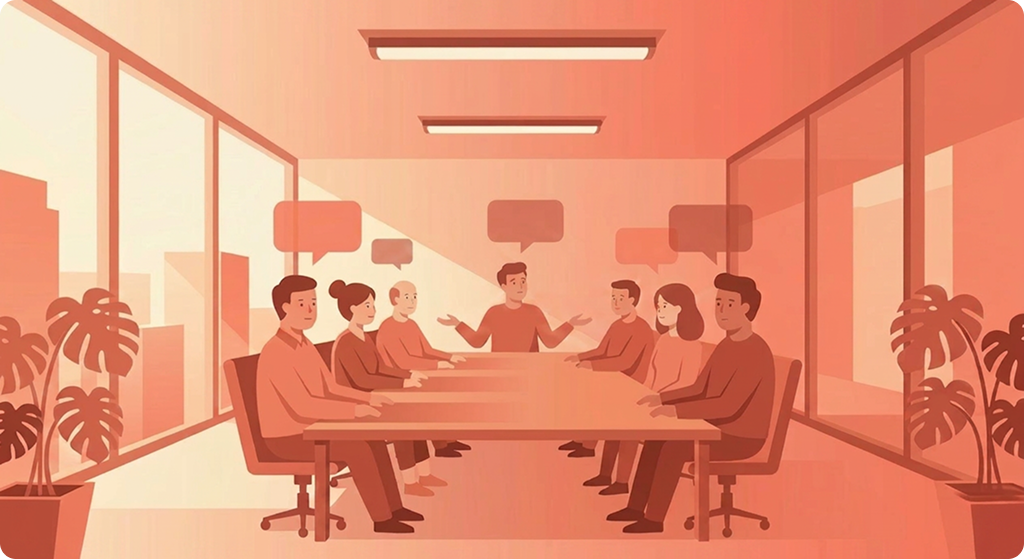
Let's get the clinical stuff out of the way.
Imposter syndrome was first described in 1978 by psychologists Pauline Clance and Suzanne Imes. They studied high-achieving women who, despite clear evidence of competence, believed they were frauds. Not underperforming. Not unskilled. Convinced, deep down, that they had somehow fooled everyone.
It's not a diagnosis. It's a pattern. And it shows up everywhere — surgeons, CEOs, professors, athletes. But here's the thing. It hits facilitators differently, and the reason matters.
Most professionals have a deliverable. A surgeon completes a procedure. An engineer ships code. A lawyer files a brief. The output is tangible. You can point at it. When the voice whispers "you're a fraud," there's a concrete thing to point back at: yeah, but look at what I built.
Facilitators don't get that. Our deliverable is what other people produce. A good workshop ends with the group's ideas on the wall, not ours. The better we do the job, the more invisible we become. So when the voice says, "you didn't really do anything," it's harder to argue.
Now add the weird intimacy of the role. You're standing in front of a room of people, asking them to be vulnerable, to share half-formed ideas, to disagree with their boss. You're asking for trust. The whole time, a part of your brain is screaming: why would they trust you? What makes you qualified to hold this space?
Here's what I've learned after running hundreds of these. That question isn't weakness. It's awareness.
The facilitators who scare me aren't the ones who feel like frauds. They're the ones who don't.
The practice: When the voice shows up in your next session, write down what it's saying. One sentence on a sticky note. Underneath it, write the awareness it's pointing to. "I'm not the smartest person in this room" becomes "I should listen more than I talk." Reframe in real time. The doubt was already useful. Now it's actionable.
Chapter checklist
Chapter Two
The Five Faces of Facilitator Fraud
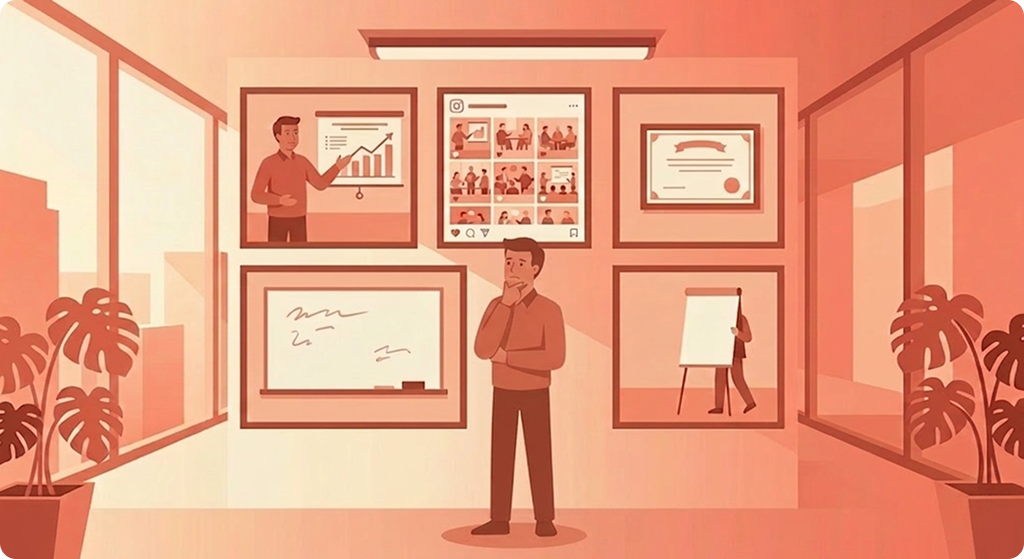
Imposter syndrome doesn't always sound the same. After years of comparing notes with other facilitators and being honest about my own patterns, I've noticed it shows up in five distinct ways. Think of them as five masks on the same face.
If you've felt facilitator imposter syndrome, you've worn at least three of these. Probably more.
1. The Expertise Gap
"They know more about this topic than I do."
This is the most common one, and it's based on a fundamental misunderstanding of the job. You're not in the room because you're the subject matter expert. You're in the room because the experts can't facilitate themselves. They're too close to the problem. That is literally why you exist.
The participant who knows everything about the product roadmap can't simultaneously hold space for competing priorities. That's your job. Different skill, not lesser skill.
2. The Comparison Trap
"I'm not as good as that other facilitator."
Social media made this worse. I had a session two springs ago that produced exactly eleven sticky notes. Eleven. The whiteboard looked like a half-empty parking lot. That afternoon I scrolled LinkedIn and watched three different facilitators post photos of perfect affinity walls and beaming participants. I closed the app and ate a sandwich in the rain.
What I didn't see is what they don't post: the session they ran two weeks earlier that completely bombed. Nobody posts those. You're comparing your behind-the-scenes footage to everyone else's highlight reel.
3. The Authority Question
"Who gave me permission to do this?"
This one hits hardest if you didn't come through a traditional facilitation path. Maybe you're a designer who started running workshops out of necessity. Maybe you're a manager who realized meetings needed structure. Maybe nobody handed you a certificate that says "Official Facilitator."
Good. Some of the best facilitators I know came in sideways. They bring fresh perspectives precisely because they didn't learn the "right" way.
4. The Outcome Worry
"What if this doesn't work?"
This one gets me. Not "what if I'm bad at this." More like, what if the workshop just doesn't produce anything useful? What if we spend two hours and end up exactly where we started?
Valid concern. Workshops can fail. But here's the thing. The facilitator who worries about outcomes is the one who designs for them. The one who doesn't worry shows up with a vague agenda and hopes for the best.
5. The Recovery Fear
"What if something goes wrong and I can't handle it?"
The senior leader who takes over. The activity that falls flat. The argument that gets personal. The Wi-Fi that dies fifteen minutes in. Every facilitator has a disaster movie playing in their head before a session.
Honestly? Some version of those things will happen. Eventually. The question isn't whether you can prevent them. It's whether you can respond. And response is a skill that only gets built by being in the room. No amount of worrying replaces experience. But a healthy amount of worrying keeps you prepared.
The practice: Before your next workshop, name which of the five is loudest right now. One sentence: "My biggest fear is X." Then write the reframe next to it. The voice gets smaller the moment you name it.
Chapter checklist
Chapter Three
The Confident Ones Should Worry More
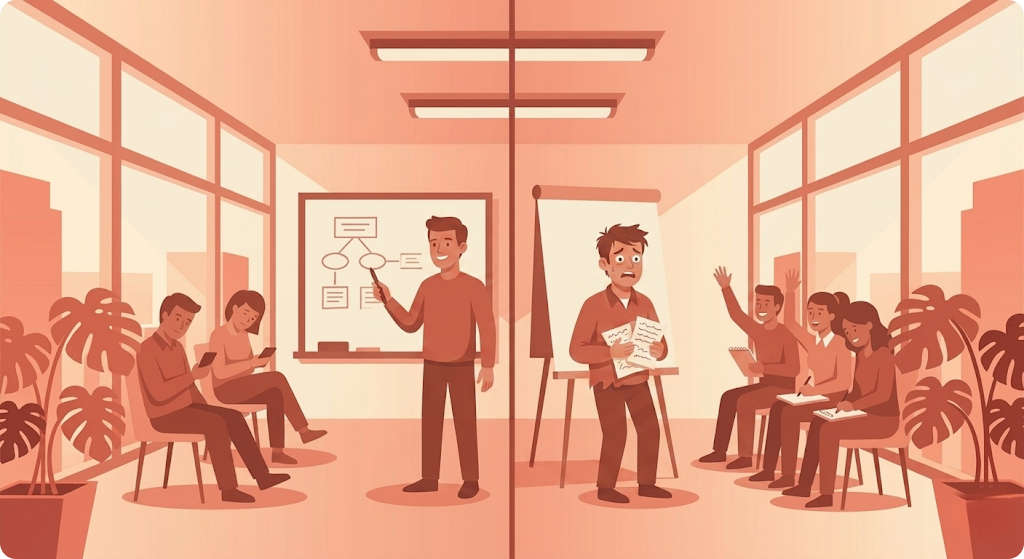
I want to say something that might sound counterintuitive: a little imposter syndrome makes you a better facilitator.
Not a lot. Not the kind that paralyzes you or makes you cancel sessions. But the kind that keeps you humble — the kind that makes you over-prepare, check in with the room, and listen to the answer when you ask "how's everyone doing?"
That's not a bug. That's a feature.
A few years ago I co-facilitated with someone who never doubted himself. Beautiful slides. Crisp transitions. He hit every timestamp on the agenda. Around 2:45 in the afternoon I noticed three of the eight participants had glazed over and one was on her phone under the table. He didn't. He kept going. The deck called for ideation, so we ideated, into a room that had quietly checked out forty minutes earlier. The output was thin. He left the session pleased with how it ran.
I've thought about that workshop a lot. He wasn't feeling like a fraud. That was the problem. He wasn't questioning whether what he was doing was working.
Facilitation is fundamentally about holding space for other people's thinking. That requires a certain amount of ego suppression. The facilitators I admire care more about the group's process than about how they look running it. They change the plan when the room needs something different. They listen more than they talk. The doubt is what keeps them doing those things.
The facilitators who never doubt themselves tend to be the ones who bulldoze through the agenda regardless of what the room needs. They mistake confidence for competence.
The research backs this up. The Dunning-Kruger effect shows that people with the least competence often have the most confidence, while highly competent people tend to underestimate their abilities. If you're worried you're not good enough, you're statistically more likely to be better than you think.
That doesn't make the feeling go away. But maybe it reframes it.
Your imposter syndrome is your quality control system. It's the part of you that says, "This matters, so I should care about doing it well." The day you stop feeling it entirely is the day to check whether you've gotten better — or whether you've stopped paying attention.
The practice: After your next session, ask one participant for one piece of unfiltered feedback. Not "how did it go." Try "what would have made that more useful for you?" The doubt sharpens when it has data to work with instead of a vacuum to fill.
Chapter checklist
Chapter Four
The Pre-Session Spiral (And How to Use It)

Every facilitator I respect has a version of The Spiral. That period — sometimes the night before, sometimes the morning of, sometimes sitting in the parking garage — where the doubt hits hardest.
You can't eliminate it. I've tried. But you can change your relationship with it. Here's what works for me.
Name it
The worst thing about The Spiral is when it operates in the background — a low hum of dread you can't quite identify. So I say it out loud. Literally. In my car, in the bathroom, wherever. "I'm feeling imposter syndrome right now. That's what this is."
Sounds dumb. Works anyway. Naming the feeling takes it from a full-body experience to a thought you can examine.
Separate preparation from reassurance
There's a difference between "I should review my notes one more time because I want to be sharp" and "I should review my notes one more time because I'm terrified."
The first one is preparation. The second one is anxiety dressed up as productivity. You won't find confidence at the bottom of one more run-through. At some point, you're prepared enough. Close the laptop.
Remember a specific success
Not "I've done this before, and it went fine." That's too vague. Your brain will argue with vagueness.
Instead: "Remember the session where the VP said it was the most productive meeting she'd had all year?" Pick a specific moment. A specific face. A specific piece of feedback. Make it real.
Accept the gap
Here's the part most advice skips: sometimes the feeling is partially right. Maybe you are stretching into a new type of workshop. Maybe this group is more senior than you're used to. Maybe you haven't done enough of these yet.
That's okay. You don't need to be the world's best facilitator to run a good session. You need to be good enough — and then get better by doing it.
The gap between where you are and where you want to be isn't evidence of fraud. It's evidence of growth.
The practice: Run the four steps in order before your next session. Name it, separate prep from reassurance, remember a specific success, accept the gap. Twenty minutes total. Don't skip the one that feels silly — that's usually the one you needed most.
Chapter checklist
Chapter Five
What to Do Mid-Workshop When It Hits
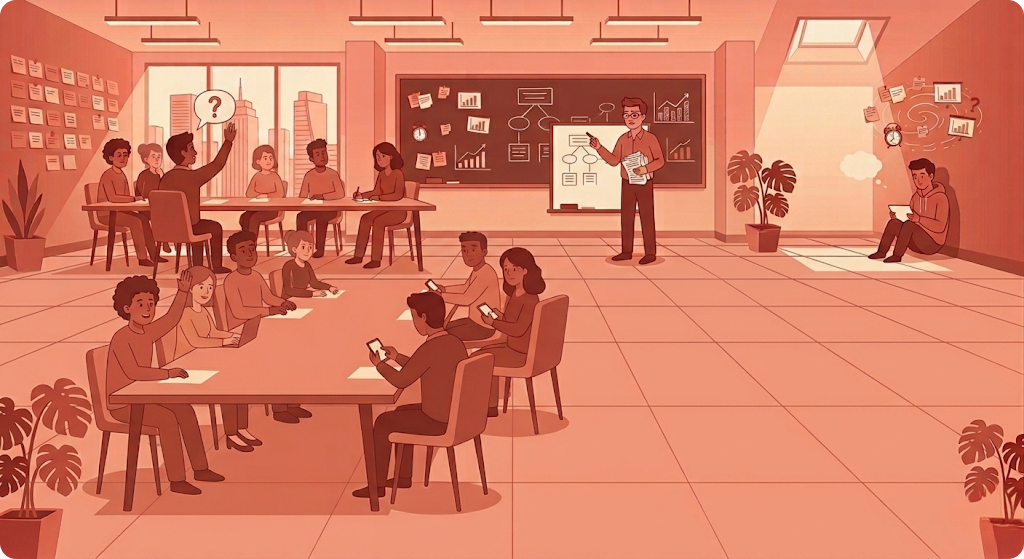
The pre-session version is one thing. But imposter syndrome can also show up at the worst possible moment — while you're standing in front of the room.
Someone asks a question you don't know the answer to. An activity falls flat. A senior person pushes back on your process. And suddenly the voice is back: they can tell. They know you're faking it.
Here are four moves that work in the moment. Memorize them in this order.
1. Buy time before you respond
You don't have to respond instantly. "That's a great question — let me think about that for a second" is a complete sentence. So is "Let me capture that and come back to it." Nobody expects you to have instant answers to everything. The pressure to respond immediately is self-imposed. Take the beat.
2. Hand the question back to the room
When you don't know the answer, the room almost always does. "I'm not sure I'm the right person to answer that — who here has experience with this?"
This isn't a weakness. This is the job. You're not the expert. You're the person who helps the experts think together. Redirecting to the room is doing your job, not avoiding it.
3. Name what's happening, not what you're feeling
If an activity isn't working, don't announce, "I'm panicking." Do say, "This doesn't seem to be clicking — let's try a different approach."
The group doesn't know your internal state. They only see your behavior. A facilitator who adapts in real time looks more competent than one who sticks rigidly to a failing plan. Your pivot is a strength, not a confession.
4. Shrink the frame to the next five minutes
Mid-session anxiety is usually catastrophizing. "This is a disaster" when really it's just "this activity isn't landing."
Bring it back to right now. Not "what will they think of me after this" but "what does this group need in the next five minutes?" Small frame. Immediate action. That's manageable.
The practice: Pick the move you're weakest at — most facilitators struggle with #1 (buying time). Try it once in a non-workshop conversation this week. A meeting. A stand-up. Get the muscle memory before you need it under pressure.
Chapter checklist
Chapter Six
Building Your Confidence Stack

I don't think you can eliminate imposter syndrome. But you can build a stack of evidence against it. Each piece alone doesn't silence the voice. Together, they make it quieter.
Keep a wins file
A document — notes app, Google Doc, whatever — where you write down every positive thing that happens in your facilitation work. The comment from a participant. The email from a client. The moment you pivoted mid-session and it worked. The session that just felt right.
Review it before big sessions. Not to convince yourself you're amazing. Just to remind yourself of what you conveniently forget when the doubt kicks in.
Debrief with other facilitators
Imposter syndrome thrives in isolation. The moment you say "I felt like a fraud in that session" to another facilitator, and they say "me too, last week," something shifts. You realize this is a shared experience, not a personal deficiency.
Find a peer. A mentor. A community. Someone you can be honest with about the messy parts of the work.
Get reps in low-stakes rooms
Confidence comes from evidence, and evidence comes from experience. If the big workshops feel overwhelming, run smaller ones. Facilitate a team retro. Run a thirty-minute brainstorm. Lead a lunch-and-learn.
Each one adds to your stack. Each one gives you a reference point when the voice says, "you can't do this." You can. You have. Here's the list.
Study your craft
Part of imposter syndrome is the fear that you're not qualified. One antidote is to invest in your skills — not to satisfy the voice, but because getting better at something creates genuine confidence that's hard to argue with.
Read about facilitation. Watch other facilitators work. Try new techniques. Take the Workshopr DNA quiz to understand your natural style — knowing your strengths makes the doubt about your weaknesses feel more proportionate.
Separate identity from performance
A workshop that doesn't go well is a workshop that didn't go well. It's not proof you're a bad facilitator. It's not a referendum on your worth as a human.
This is easy to write and hard to practice. I still feel the sting of a session that falls flat. But the faster you can move from "I am a failure" to "that session had problems I can learn from," the faster you recover. And recovery speed matters more than perfection.
The practice: Start the wins file today. Three lines. The most recent positive thing a participant said. The most recent moment you adapted in real time. The most recent session where you walked out lighter than you walked in. Open it before your next workshop.
Chapter checklist
Chapter Seven
The Paradox
Here's where I'll leave you.
The thing I couldn't see in that parking garage — the thing I wish someone had told me — is that doubt and skill aren't opposites. They're the same thing, seen from different angles.
The voice that says "who are you to hold this space?" is the same voice that says "this space matters." The anxiety before a session is the flip side of caring deeply about the people in the room. The fear of getting it wrong is what drives you to prepare, to listen, to adapt.
After a year of doing this work on yourself, the voice doesn't disappear. But its pitch changes. It stops sounding like an accusation and starts sounding like a check-in. Less "you're a fraud," more "pay attention." You learn to nod at it, not argue with it. That nod is the whole shift.
I'm not going to tell you to "believe in yourself." That's a bumper sticker, not a strategy. What I will tell you is this:
The facilitators who change rooms aren't the ones who feel confident. They're the ones who feel the doubt and walk in anyway.
They design for the group instead of their ego. They care enough to worry about whether it's working. That's you. If you're reading this book, that's you.
The voice in the parking garage isn't your enemy. It's your conscience. It's the part of you that takes this work seriously. And the world needs more people who take this work seriously.
So feel the fear. Then get out of the car.
Appendix · Print these
The Five Faces Reference Cards
Print these. Keep them in your facilitation kit, your notebook, or the back of your laptop. Each card tells you what the face sounds like, the reframe to hold onto, and the move to make in the moment. Hover or tap a card to flip it.
The Expertise Gap
Sounds like"They know more about this topic than I do."
cachedReframe
You weren't hired to know more. You were hired because the experts can't facilitate themselves.
The move
Open the session by naming the room's expertise out loud. Position yourself as the architect of the conversation, not its source.The Comparison Trap
Sounds like"I'm not as good as that other facilitator."
cachedReframe
You're comparing your behind-the-scenes footage to their highlight reel.
The move
Mute the social feed for 24 hours before a session. Open your wins file instead.The Authority Question
Sounds like"Who gave me permission to do this?"
cachedReframe
Some of the best facilitators came in sideways. The non-traditional path is a feature.
The move
Write down the three skills from your day job that transfer directly to facilitating. Use them as your authority.The Outcome Worry
Sounds like"What if this doesn't work?"
cachedReframe
The facilitator who worries about outcomes is the one who designs for them.
The move
Define one non-negotiable outcome for the session. Everything else is negotiable. Hold the outcome loosely; hold the process even more loosely.The Recovery Fear
Sounds like"What if something goes wrong and I can't handle it?"
cachedReframe
Some of it will go wrong. Response is a skill — and only the room teaches it.
The move
Pre-write three sentences you can say when something stalls: a buy-time, a redirect-to-room, and a name-what's-happening. Carry them in your notes.What's next
Three Things to Do This Week
This book is a theory until you carry it into a room.
Take the Facilitator's DNA Quiz
Three minutes. Understand your natural facilitation style and where your real strengths are — not where imposter syndrome tells you they aren't.
Workshopr DNA — discover whether you're an Energizer, Architect, Connector, Explorer, or Sage.
Take the quizarrow_forwardBrowse the exercise library
Workshopr.io's library has exercises, icebreakers, and full workshop templates with step-by-step instructions. The more tools you have on the shelf, the harder it is for doubt to convince you you're unprepared.
The library — thousands of exercises, filterable by goal, duration, and group size.
Browse the libraryarrow_forwardPlan your next workshop
Workshopr.io is where the techniques in this series turn into an actual agenda. Drop activities onto a timeline, time the energy arc, and walk into your next session with a plan that holds — not a hope.
The Planner — and if your first session is still ahead of you, start with Book 1: the sprint plan with scope, agenda, scripts, and the follow-up template.
Start with Book 1arrow_forwardBack matter
The Workshopr Facilitation Series
This is Book 5 of 6 in The Workshopr Facilitation Series.
The Series
Run Your First Design Workshop in 72 Hours
A day-by-day sprint plan for your first workshop. 7 chapters.
Facilitating With Intention
The mindsets, methods, and moves that separate good facilitators from great ones. 7 chapters.
Did It Work?
Measuring workshop impact when half of it can't be put on a slide. 8 chapters.
They'll Never Say Yes
Selling internal workshops to leaders who think they don't have time. 6 chapters.
Get Out of the Car — you are here
On running rooms where you're not the most senior, the most expert, or the most expected. 8 chapters.
The Synthesis Playbook
AI-assisted recipes for turning workshop outputs into defensible decisions. 12 chapters.