Workshop Facilitation Series — The complete facilitator's playbook

Be the conductor,
not the soloist.

Book 2 · After your first one

You led your first workshop. The room held together. But you can feel the gap between what happened and what could have happened. Book 1 got you through the door. This book is about what happens when you decide to get good.

arrow_downwardScroll — mindset, architecture, space, technique
70%Of facilitation skill is how you think about your role — not technique
5Mindset shifts that separate good facilitators from great ones
10Techniques in your library — four from Book 1, six new ones here
5Space layouts, with the scenarios where each one wins

The Playbook — Everything in the book

The best conductors don't perform. They create the conditions for others to play their best.

01

Chapters 1–2 · Mindset

The Five Mindset Shifts

Facilitation skills are 30% technique and 70% how you think about your role. Facilitators with perfect agendas produce mediocre outcomes in the wrong headspace; facilitators with thin agendas produce extraordinary ones because they understood what was actually happening in the room.

architecture

Shift 1 — From expert to architect

Your job isn't to have the best answer. It's to design the process that surfaces the best answer from the group.

The practice: Before every workshop, write down your opinions about the topic. Then put that paper in your bag. Your opinions are not part of the agenda.
water

Shift 2 — From control to containment

Set the boundaries — the timebox, the objective, the ground rules — then let the group move freely within them. Build the riverbank, don't dam the river.

The practice: Identify the one non-negotiable outcome. Everything else is negotiable. Hold the outcome loosely. Hold the process even more loosely.
hearing

Shift 3 — From talking to listening

Most people listen to respond. Facilitators listen to understand — for what's not being said as much as what is. The best facilitators spend more time watching faces than reading sticky notes.

The practice: Pause for 3 seconds before you respond. Count "one-Mississippi, two-Mississippi, three-Mississippi." Someone else often jumps in with something better.
route

Shift 4 — From perfection to progress

A workshop fails when it produces no outcome. Everything else — flat activities, derailed discussions, fifteen minutes over — is just facilitation, the real-time art of adjusting.

The practice: After every workshop, write down one thing that didn't go as planned and how you handled it. After ten workshops, you'll have seen most of what can go wrong.
bolt

Shift 5 — From neutrality to productive tension

A purely neutral facilitator can moderate a polite discussion that produces nothing. The real skill is surfacing the disagreements people are too polite to say out loud, then giving the group a structured way to work through them.
Say this: "Everyone seems to agree, which makes me nervous. What's the argument against this?" · "I think there's a deeper disagreement underneath this one. Can someone name it?"
02

Chapter 3 · Architecture

Advanced Agenda Architecture

Book 1 gave you the five-part structure. As your skills grow, you need more sophisticated machinery: nested cycles, multi-day design, recovery paths, and agendas that adapt in real time.

cyclone

Nested diverge-converge cycles

A full-day product strategy workshop runs four cycles, each narrowing the funnel: problem space → deep dive → solutions → commitment. The group moves from "everything is a problem" to "here's what we're doing and who's doing it."

The architecture rule: Every diverge phase must be followed by a converge phase before the next diverge begins. Diverge twice without converging and you get an overwhelmed group drowning in options.
date_range

Multi-day design

Day 1: explore and align — end with the group clearly seeing the problem. Day 2: create and decide. Day 3, if included: planning and commitment.

The overnight effect: Start Day 2 with "What came up for you overnight? Any new thoughts since yesterday?"
alt_route

Recovery paths

Build them in before you need them: the cuttable activity (one per half-day), the accordion activity (±15 minutes without losing value), and the emergency pivot when a prompt doesn't resonate.

Backup prompt: "Pause for five minutes of silent writing on this question instead: [simpler, more direct question]. Then share around the table."
fork_right

Adaptive agendas

Design the morning in detail; prepare two or three afternoon options. If the group aligned quickly → jump to ideation. If they couldn't agree → deeper stakeholder analysis. If conflict surfaced → a facilitated alignment session. Announce the afternoon after lunch as though it were always the plan.

03

Chapter 5 · Technique

The Technique Library

Six new techniques with full scripts, timing, and materials. Combined with the four from Book 1, you have ten building blocks you can mix and match for years. Mastery isn't collecting techniques — it's knowing when each one belongs.

New technique
Time
What it does
Lightning Demos
30–40 min
Surfaces existing solutions and inspiration from inside and outside your industry — anchors ideation in what's possible.
Rose, Thorn, Bud
20–30 min
A balanced retrospective: what's working, what's painful, and what isn't working yet but has potential.
Silent Critique
20–30 min
Honest feedback without social pressure — sticky notes do the initial talking, so feedback lands on the work, not the person.
Storyboarding
30–45 min
Turns abstract ideas into concrete user scenarios. Sketching forces specificity and surfaces gaps faster than discussion.
Assumption Mapping
25–35 min
Identifies the hidden beliefs driving decisions — and finds the one that, if wrong, makes everything else irrelevant.
Forced Ranking
20–30 min
Eliminates ties and creates clear priority order by forcing trade-offs. Dot voting shows preference; forced ranking shows priority.
style

Appendix: 10 printable reference cards

Every technique — all ten — condensed onto printable cards with duration, group size, materials, and word-for-word instructions. Print them, keep them in your facilitation kit.

04

Chapter 6 · Live

Reading the Room & Recovering

Techniques and agendas are the easy part. The hard part is what you do when the plan meets reality. This isn't mystical intuition — it's pattern recognition.

smartphone

Phones appearing

One phone is a personal emergency. Three phones mean the group has checked out. Your move: change the format — full group to pairs, pairs to writing, anything seated to standing.

front_hand

Cross-armed postures multiplying

When half the room crosses their arms, they're disagreeing or disengaging.

Say this: "I'm sensing some tension in the room. What's not being said?"
record_voice_over

The same two people talking

The rest of the group has ceded the conversation or given up on airtime.

Say this: "I want to pause and hear from someone who hasn't spoken yet. [Name], what's your read on this?"
sentiment_satisfied

Laughter that avoids vs. breaks tension

If the group keeps cracking jokes when the conversation gets hard, name it.

Say this: "We keep finding our way back to humor. I think there might be something uncomfortable we're circling around."
medical_services

The recovery toolkit

When an activity falls flat: pause, give a simpler prompt, no apologizing. When conflict escalates: contain it — capture both positions on the wall. When you run out of time: cut transparently and protect synthesis. When the decision-maker overrides the group: don't argue — document both the call and the group's top-voted option.

The three-minute self-check (every break): Is the group making progress toward the objective? Is the energy where it needs to be for the next activity? Is anyone lost, frustrated, or checked out?
05

Chapter 7 · Career

Building Your Facilitation Practice

You don't become a great facilitator by reading about it. You become one by facilitating, reflecting, and repeating.

edit_note

The post-workshop debrief

Within 24 hours, write four things: what worked, what didn't, what surprised you, and one thing to try next time. After ten workshops you'll have a pattern library more valuable than any book.

stairs

The skill progression

Workshops 1–5: following the script. 6–15: reading the signals. 16–30: designing for the group. 30+: invisible facilitation — the group experiences a smooth conversation, not a managed process.

search

Finding your next workshops

If your organization doesn't hand you workshops, go looking: facilitate your team's next retro, volunteer to run a cross-functional brainstorm, propose a design critique for a project stuck in review limbo. Every session where you're responsible for the process — even a 30-minute one — is a rep.

The five space layouts — the room is never neutral.

Pods whisper "collaborate." Theater rows announce "listen and absorb." A U-shape declares "we're all equals here." Chapter 4 covers all five, with diagrams, use cases, and facilitator tips. Drag to explore.

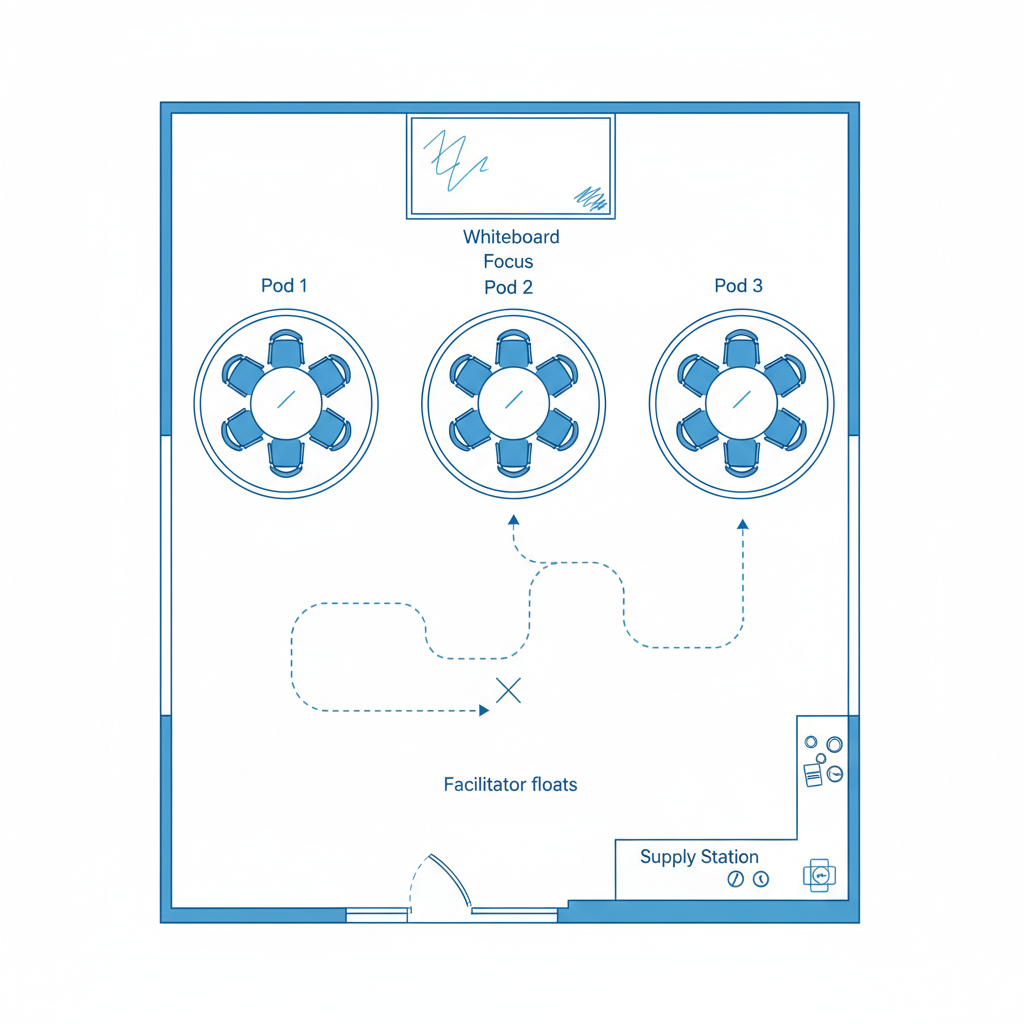
Pod layout diagram: small table clusters facing a focal wall
01 · The Podyour default
The Pod Layout

Four to six small tables, three to five people each, angled toward a shared focal wall. Optimal for ideation, design sprints, and alternating small-group / full-group work.

Circulate among the pods during small-group activities — don't camp at one.

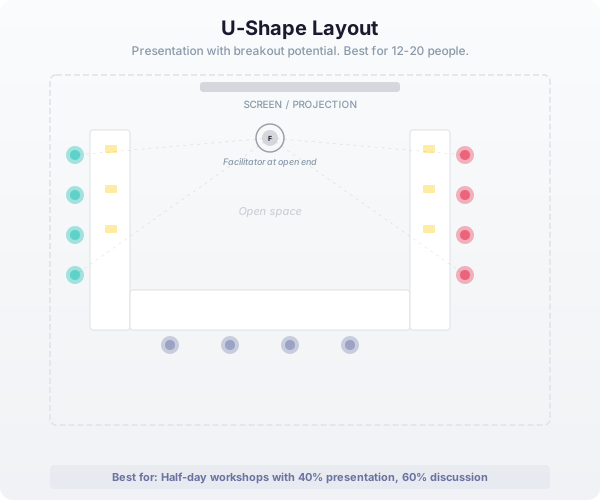
U-shape layout diagram
02 · The U-Shape8–15 people
The U-Shape

Tables in a horseshoe, everyone facing inward, facilitator at the open end. Built for discussion-focused workshops, stakeholder alignment, and decisions — no back row.

During discussions, move to the side so conversation flows across the U, not through you.

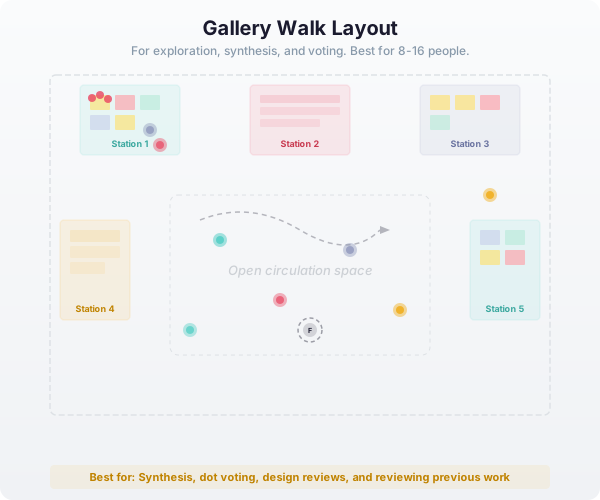
Gallery layout diagram: stations around the walls
03 · The Galleryvisual review
The Gallery

No central tables — the walls are the workspace, with stations around the room. Ideal for gallery walks, critiques, and dot voting. Movement changes cognitive states.

Number each station: "Begin at the station nearest you. Eight minutes, then rotate clockwise."

04 · The Fishbowl15+ people
The Fishbowl

An inner circle of four to six chairs discusses while the outer circle observes; people rotate in via one open chair. Built for contentious topics in large groups — entering the circle is a deliberate act.

Seed the inner circle with diverse perspectives. Don't put all the dominant voices in first.

05 · The Theater≤ 30 minutes
The Theater

Rows of chairs facing a stage. Right for intros, share-outs, and demos — and inherently passive. If it occupies more than a quarter of the agenda, you're running a meeting, not a workshop.

Use theater for fifteen minutes of context-setting, then physically rearrange into pods — moving furniture signals the shift from listening to participating.

Time block
Layout
Why
9:00–9:30 Opening
Theater → U-Shape
Context setting, then transition to discussion
9:30–12:00 Core work
Pods
Small-group ideation and building
1:00–2:30 Review
Gallery
Walking, voting, critiquing wall-based work
2:30–4:00 Decision
U-Shape
Full-group discussion and commitment

Allocate five minutes per layout transition — the physical rearrangement revitalizes participant energy.

Book 2 cover: Facilitating With Intention

Get the book — free.

The full PDF of Facilitating With Intention: the five mindset shifts, advanced agenda architecture, all five space layouts, six new techniques with scripts, the recovery toolkit, and the 10 printable workshop reference cards. Straight to your inbox.

That doesn't look like an email address — give it another go.

No spam. One email with the files, plus the occasional facilitation tip. Unsubscribe anytime.

mark_email_readCheck your inbox — Book 2 is on its way.

Book 1 cover: Run Your First Design Workshop in 72 Hours Book 2 cover: Facilitating With Intention Book 3 cover: Did It Work?