Pick the top three
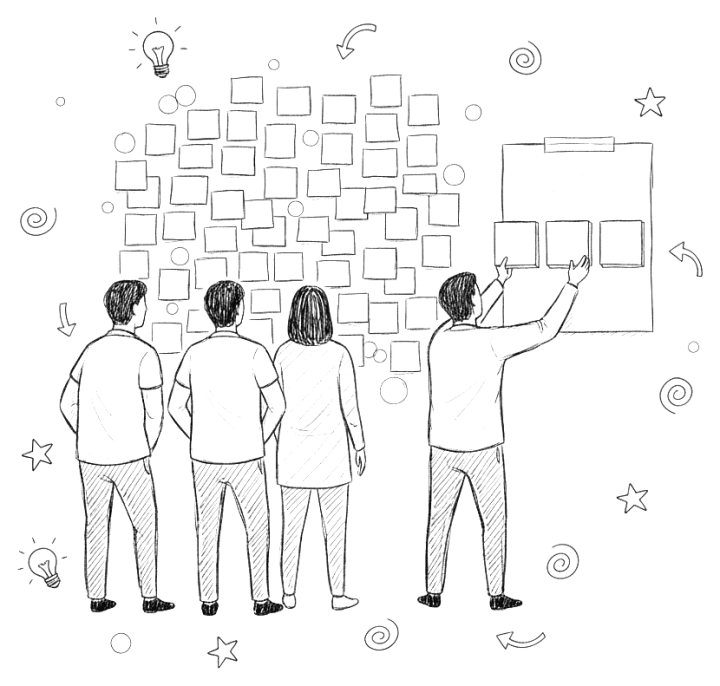
Get a long list of ideas down to the three the room will put its time behind. The writing comes before the arguing, so an idea wins on its merits, not on who said it first.
60 minutes, in person. Serves 8 to 12.
How to run it
-
Check-in
5 minSay what the room will leave with. Then ask: "One word for how you're arriving." Take the words in any order, not round the circle.
-
Brainwriting
15 minRounds: two rounds
Write the question at the top of one sheet per person, and read it out: "Write three answers each. No talking. When I call time, pass your sheet to the left and build on what's already there." Run two rounds of four minutes. Building on an idea counts: "badges for the first project" can become "badges for the first project, sent by a teammate". When the last round ends, everyone copies the two strongest ideas on the sheet in front of them onto sticky notes, one per note, and puts them on the wall.
-
Affinity Diagramming
10 minMissing-note pass: none
"Move the notes so the ones that say the same thing sit together. Anyone can move any note. Nobody talks." When the moving slows, stop the sort. Then name each cluster on a different-coloured note, in a few words that say what it's about. A note that fits nowhere stays on its own and still gets voted on.
-
Dot Voting
20 minTalk before confirming: the top three, a minute each
Give everyone three dots. "Put your dots on the clusters you'd give your own time to next month. You can stack them. Everyone votes at once, and nobody campaigns." Count the dots and write each total on the wall. Then talk through the top three, a minute each: for each, someone who wrote a note in it says why it matters, and anyone who disagrees says so. Confirm the three with a show of hands. If two tie for third, vote again on just those two.
-
Commit: who does what by when
10 minEach result the room produced needs an owner. The owner writes "I will [what] by [when]" on a card, reads it out and sticks it under the result. Only owners speak. If a result has no owner, say so: "Nobody owns this yet." Write that on the wall too, so it leaves the room as an open item rather than a quiet gap.
90 minutes, in person. Serves 8 to 12.
-
Check-in
10 minSay what the room will leave with and point to the three steps on the wall. Then ask: "In one sentence: what do you need from the next ninety minutes?" Take answers in any order, not round the circle. If someone passes, move on.
-
Brainwriting
20 minRounds: three rounds
Write the question at the top of one sheet per person, and read it out: "Write three answers each. No talking. When I call time, pass your sheet to the left and build on what's already there." Run three rounds of four minutes. Building on an idea counts: "badges for the first project" can become "badges for the first project, sent by a teammate". When the last round ends, everyone copies the two strongest ideas on the sheet in front of them onto sticky notes, one per note, and puts them on the wall.
-
Affinity Diagramming
20 minMissing-note pass: one pass
"Move the notes so the ones that say the same thing sit together. Anyone can move any note. Nobody talks." When the moving slows, stop the sort. Then name each cluster on a different-coloured note, in a few words that say what it's about. A note that fits nowhere stays on its own and still gets voted on.
In the 90 also: The missing-note pass: before naming, everyone reads the clusters and adds one note anywhere something is missing. Silent, two minutes.
-
Dot Voting
25 minTalk before confirming: the top five, two minutes each
Give everyone three dots. "Put your dots on the clusters you'd give your own time to next month. You can stack them. Everyone votes at once, and nobody campaigns." Count the dots and write each total on the wall. Then talk through the top five, two minutes each: for each, someone who wrote a note in it says why it matters, and anyone who disagrees says so. Confirm the three with a show of hands. If two tie for third, vote again on just those two.
-
Commit: who does what by when
15 minEach result the room produced needs an owner. The owner writes "I will [what] by [when]" on a card, reads it out and sticks it under the result. Only owners speak. If a result has no owner, say so: "Nobody owns this yet." Write that on the wall too, so it leaves the room as an open item rather than a quiet gap.
In the 90 also: Ask each owner one question: "What could stop this?" One sentence back. If the answer is another person, that person is in the commitment too.
90 minutes, remote. Serves 8 to 12.
-
Check-in
10 minSay what the room will leave with and show the three steps on the board. Then ask: "In one sentence: what do you need from the next ninety minutes? Type it in the chat, but don't press Enter until I say go." Say "Go" and read the chat out loud in one pass. It's faster than a round, and nobody answers in the shadow of the person before them.
-
Brainwriting
20 minRounds: three rounds
Give each person a named column on the board, with the question at the top, and read it out: "Add three ideas to your own column. No chat. When I call time, move one column to the right and build on what's there." Run three rounds of four minutes. Building on an idea counts: "badges for the first project" can become "badges for the first project, sent by a teammate". At the end, everyone copies the two strongest ideas from the column they finish on into the Ideas frame, one per sticky.
Board: Frame 1, "Brainwriting": one named column per person, with the question at the top. Frame 2, "Ideas": empty.
-
Affinity Diagramming
20 minMissing-note pass: one pass
In the Ideas frame: "Move the notes so the ones that say the same thing sit together. Anyone can move any note. No chat." Ask people to drag rather than delete: a note in the wrong cluster is information. When the moving slows, stop the sort. Then name each cluster with a sticky in a second colour, in a few words that say what it's about. A note that fits nowhere stays on its own and still gets voted on.
In the 90 also: The missing-note pass: before naming, everyone reads the clusters and adds one note anywhere something is missing. Silent, two minutes.
Board: Uses the Ideas frame. Have a second sticky colour ready for cluster names.
-
Dot Voting
25 minTalk before confirming: the top five, two minutes each
Use the board's voting tool if it has one, with three votes each and results hidden until everyone has voted; if it doesn't, give everyone three dot stickers. "Put your votes on the clusters you'd give your own time to next month. You can stack them. Everyone votes at once, and nobody campaigns." Write each total beside its cluster. Then talk through the top five, two minutes each: for each, someone who wrote a note in it says why it matters, and anyone who disagrees says so, out loud or in the chat. Confirm the three with raised hands. If two tie for third, vote again on just those two.
Board: Uses the Ideas frame. Add a "Top three" frame beside it for the results and their owners.
-
Commit: who does what by when
15 minEach result the room produced needs an owner. Owners type "I will [what] by [when]" into the Commitments frame, under the result they own. Read every commitment back out loud. If a result has no owner, say so: "Nobody owns this yet." Type that into the frame too, so it leaves the room as an open item rather than a quiet gap.
In the 90 also: Ask each owner one question: "What could stop this?" One sentence back. If the answer is another person, that person is in the commitment too.
Board: Frame "Commitments": one column per result, with space for "I will [what] by [when]".
60 minutes, in person. Serves 8 to 12.
-
Check-in
5 minSay what the room will leave with. Then ask: "One word for how you're arriving." Take the words in any order, not round the circle.
-
Brainwriting
15 minRounds: two rounds
Write the question at the top of one sheet per person, and read it out: "Write three answers each. No talking. When I call time, pass your sheet to the left and build on what's already there." Run two rounds of four minutes. Building on an idea counts: "badges for the first project" can become "badges for the first project, sent by a teammate". When the last round ends, everyone copies the two strongest ideas on the sheet in front of them onto sticky notes, one per note, and puts them on the wall.
-
Affinity Diagramming
10 minMissing-note pass: none
"Move the notes so the ones that say the same thing sit together. Anyone can move any note. Nobody talks." When the moving slows, stop the sort. Then name each cluster on a different-coloured note, in a few words that say what it's about. A note that fits nowhere stays on its own and still gets voted on.
-
Dot Voting
20 minTalk before confirming: the top three, a minute each
Give everyone three dots. "Put your dots on the clusters you'd give your own time to next month. You can stack them. Everyone votes at once, and nobody campaigns." Count the dots and write each total on the wall. Then talk through the top three, a minute each: for each, someone who wrote a note in it says why it matters, and anyone who disagrees says so. Confirm the three with a show of hands. If two tie for third, vote again on just those two.
-
Commit: who does what by when
10 minEach result the room produced needs an owner. The owner writes "I will [what] by [when]" on a card, reads it out and sticks it under the result. Only owners speak. If a result has no owner, say so: "Nobody owns this yet." Write that on the wall too, so it leaves the room as an open item rather than a quiet gap.
60 minutes, remote. Serves 8 to 12.
-
Check-in
5 minSay what the room will leave with. Then ask: "One word for how you're arriving. Type it in the chat, but don't press Enter until I say go." Say "Go" and read the chat out loud in one pass. It's faster than a round, and nobody answers in the shadow of the person before them.
-
Brainwriting
15 minRounds: two rounds
Give each person a named column on the board, with the question at the top, and read it out: "Add three ideas to your own column. No chat. When I call time, move one column to the right and build on what's there." Run two rounds of four minutes. Building on an idea counts: "badges for the first project" can become "badges for the first project, sent by a teammate". At the end, everyone copies the two strongest ideas from the column they finish on into the Ideas frame, one per sticky.
Board: Frame 1, "Brainwriting": one named column per person, with the question at the top. Frame 2, "Ideas": empty.
-
Affinity Diagramming
10 minMissing-note pass: none
In the Ideas frame: "Move the notes so the ones that say the same thing sit together. Anyone can move any note. No chat." Ask people to drag rather than delete: a note in the wrong cluster is information. When the moving slows, stop the sort. Then name each cluster with a sticky in a second colour, in a few words that say what it's about. A note that fits nowhere stays on its own and still gets voted on.
Board: Uses the Ideas frame. Have a second sticky colour ready for cluster names.
-
Dot Voting
20 minTalk before confirming: the top three, a minute each
Use the board's voting tool if it has one, with three votes each and results hidden until everyone has voted; if it doesn't, give everyone three dot stickers. "Put your votes on the clusters you'd give your own time to next month. You can stack them. Everyone votes at once, and nobody campaigns." Write each total beside its cluster. Then talk through the top three, a minute each: for each, someone who wrote a note in it says why it matters, and anyone who disagrees says so, out loud or in the chat. Confirm the three with raised hands. If two tie for third, vote again on just those two.
Board: Uses the Ideas frame. Add a "Top three" frame beside it for the results and their owners.
-
Commit: who does what by when
10 minEach result the room produced needs an owner. Owners type "I will [what] by [when]" into the Commitments frame, under the result they own. Read every commitment back out loud. If a result has no owner, say so: "Nobody owns this yet." Type that into the frame too, so it leaves the room as an open item rather than a quiet gap.
Board: Frame "Commitments": one column per result, with space for "I will [what] by [when]".
Comments & Discussion
Add a Comment
Recent Comments (3)
This workshop was incredibly effective for our remote team! We adapted it slightly for a virtual setting and it worked wonderfully. The key was breaking into smaller breakout rooms.
Great resource! One tip: prepare all materials the day before to avoid any last-minute rushes.
Used this for our quarterly planning session. The structured approach really helped us stay on track!