Understand an experience
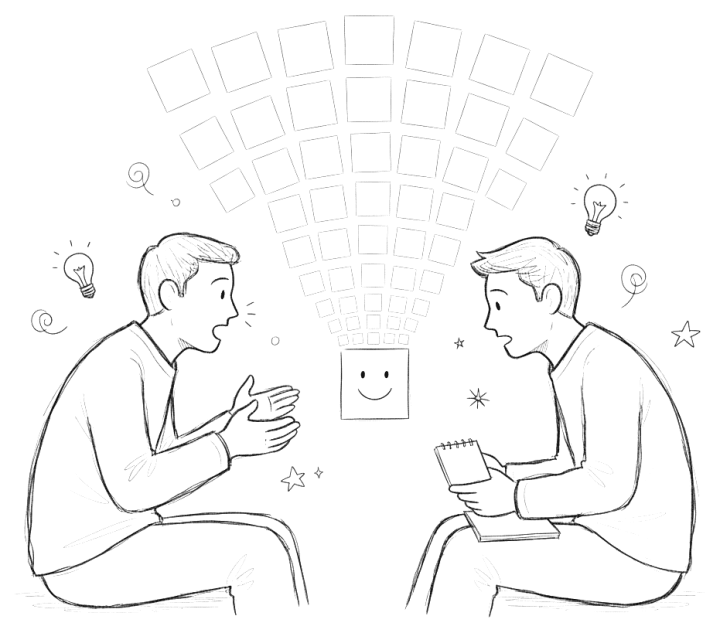
Hear the room's own stories about a problem and turn them into one sentence about who has it and what they need. Use it when the people in the room have lived the problem, or when you've invited people who have.
60 minutes, in person. Serves 8 to 12.
How to run it
-
Check-in
5 minSay what the room will leave with. Then ask: "One word for how you're arriving." Take the words in any order, not round the circle.
-
5-Minute User Interview
20 minInterview rounds: two rounds
Put people in threes: an interviewer, a storyteller and a note-taker. Give one prompt, recent and specific: "Tell me about the last time you [had the problem]." Interviewers ask "What happened next?" and "Why was that?", never "Would you…?". Note-takers write one thing they heard per sticky, in the storyteller's words where they can. Run two rounds of five minutes, with two minutes after each to swap roles. Afterwards, every note goes on the wall.
-
Affinity Diagramming
10 minWhat each cluster's name holds: the need alone
"Move the notes so the ones about the same thing sit together. Anyone can move any note. Nobody talks." When the moving slows, name each cluster with the need alone, writing the need as a sentence: "They need to know the deadline is real", not "Deadlines". A note that fits nowhere stays where it is; a single note can be the most important thing on the wall.
-
Point of View Statement
15 minWho drafts: the whole room, together
Put the template on the wall: "[Who] needs [what] because [what we heard]." Point at the strongest need and write the sentence with the room: you hold the pen while volunteers call out pieces. "Use their words where you can. No solutions in the sentence." Read it back and write it at the top of the wall. If it would surprise someone who wasn't in the room, it's done; if it wouldn't, ask what the storytellers said that nobody expected.
-
Commit: who does what by when
10 minEach result the room produced needs an owner. The owner writes "I will [what] by [when]" on a card, reads it out and sticks it under the result. Only owners speak. If a result has no owner, say so: "Nobody owns this yet." Write that on the wall too, so it leaves the room as an open item rather than a quiet gap.
90 minutes, in person. Serves 8 to 12.
-
Check-in
10 minSay what the room will leave with and point to the three steps on the wall. Then ask: "In one sentence: what do you need from the next ninety minutes?" Take answers in any order, not round the circle. If someone passes, move on.
-
5-Minute User Interview
25 minInterview rounds: three rounds
Put people in threes: an interviewer, a storyteller and a note-taker. Give one prompt, recent and specific: "Tell me about the last time you [had the problem]." Interviewers ask "What happened next?" and "Why was that?", never "Would you…?". Note-takers write one thing they heard per sticky, in the storyteller's words where they can. Run three rounds of five minutes, with two minutes after each to swap roles. Afterwards, every note goes on the wall.
In the 90 also: The third round means everyone has been interviewer, storyteller and note-taker once, so every story in the room gets heard by someone writing it down.
-
Affinity Diagramming
20 minWhat each cluster's name holds: the need, plus the quote that says it best
"Move the notes so the ones about the same thing sit together. Anyone can move any note. Nobody talks." When the moving slows, name each cluster with the need, plus the quote that says it best, writing the need as a sentence: "They need to know the deadline is real", not "Deadlines". A note that fits nowhere stays where it is; a single note can be the most important thing on the wall.
-
Point of View Statement
20 minWho drafts: each interview trio, then the room picks one
Put the template on the wall: "[Who] needs [what] because [what we heard]." Point at the strongest need on the wall. Each interview trio drafts one sentence together: "Use their words where you can. No solutions in the sentence." Post the drafts, and everyone stars the one closest to true. Read it out and let the room fix it, at most three edits, then write it at the top of the wall. If it would surprise someone who wasn't in the room, it's done; if it wouldn't, ask what the storytellers said that nobody expected.
-
Commit: who does what by when
15 minEach result the room produced needs an owner. The owner writes "I will [what] by [when]" on a card, reads it out and sticks it under the result. Only owners speak. If a result has no owner, say so: "Nobody owns this yet." Write that on the wall too, so it leaves the room as an open item rather than a quiet gap.
In the 90 also: Ask each owner one question: "What could stop this?" One sentence back. If the answer is another person, that person is in the commitment too.
90 minutes, remote. Serves 8 to 12.
-
Check-in
10 minSay what the room will leave with and show the three steps on the board. Then ask: "In one sentence: what do you need from the next ninety minutes? Type it in the chat, but don't press Enter until I say go." Say "Go" and read the chat out loud in one pass. It's faster than a round, and nobody answers in the shadow of the person before them.
-
5-Minute User Interview
25 minInterview rounds: three rounds
Put people in threes in breakout rooms for the whole step; this is the recipe's one breakout round. In each room there's an interviewer, a storyteller and a note-taker, rotating every round. The prompt: "Tell me about the last time you [had the problem]." Interviewers ask "What happened next?" and "Why was that?", never "Would you…?". Note-takers type one thing they heard per sticky into the Heard frame, in the storyteller's words where they can. Run three rounds of five minutes, with two minutes after each to swap roles.
In the 90 also: The third round means everyone has been interviewer, storyteller and note-taker once, so every story in the room gets heard by someone writing it down.
Board: Frame 1, "Heard": open space for notes, one thing heard per sticky.
-
Affinity Diagramming
20 minWhat each cluster's name holds: the need, plus the quote that says it best
In the Heard frame: "Drag the notes so the ones about the same thing sit together. Anyone can move any note. No chat." When the moving slows, take a sticky of a second colour and name each cluster with the need, plus the quote that says it best, writing the need as a sentence: "They need to know the deadline is real", not "Deadlines". A note that fits nowhere stays where it is; a single note can be the most important thing on the wall.
Board: Uses the Heard frame. Have a second sticky colour ready for the needs.
-
Point of View Statement
20 minWho drafts: each interview trio, then the room picks one
Put the template at the top of the Problem frame: "[Who] needs [what] because [what we heard]." Point at the strongest need. Everyone drafts the sentence alone in the frame; the breakout round is already used. Then everyone stars the draft closest to true, and you read it out and let the room fix it, at most three edits. "Use their words where you can. No solutions in the sentence."
Board: Frame 2, "Problem": the template at the top, with space for drafts and the final sentence.
-
Commit: who does what by when
15 minEach result the room produced needs an owner. Owners type "I will [what] by [when]" into the Commitments frame, under the result they own. Read every commitment back out loud. If a result has no owner, say so: "Nobody owns this yet." Type that into the frame too, so it leaves the room as an open item rather than a quiet gap.
In the 90 also: Ask each owner one question: "What could stop this?" One sentence back. If the answer is another person, that person is in the commitment too.
Board: Frame "Commitments": one column per result, with space for "I will [what] by [when]".
60 minutes, in person. Serves 8 to 12.
-
Check-in
5 minSay what the room will leave with. Then ask: "One word for how you're arriving." Take the words in any order, not round the circle.
-
5-Minute User Interview
20 minInterview rounds: two rounds
Put people in threes: an interviewer, a storyteller and a note-taker. Give one prompt, recent and specific: "Tell me about the last time you [had the problem]." Interviewers ask "What happened next?" and "Why was that?", never "Would you…?". Note-takers write one thing they heard per sticky, in the storyteller's words where they can. Run two rounds of five minutes, with two minutes after each to swap roles. Afterwards, every note goes on the wall.
-
Affinity Diagramming
10 minWhat each cluster's name holds: the need alone
"Move the notes so the ones about the same thing sit together. Anyone can move any note. Nobody talks." When the moving slows, name each cluster with the need alone, writing the need as a sentence: "They need to know the deadline is real", not "Deadlines". A note that fits nowhere stays where it is; a single note can be the most important thing on the wall.
-
Point of View Statement
15 minWho drafts: the whole room, together
Put the template on the wall: "[Who] needs [what] because [what we heard]." Point at the strongest need and write the sentence with the room: you hold the pen while volunteers call out pieces. "Use their words where you can. No solutions in the sentence." Read it back and write it at the top of the wall. If it would surprise someone who wasn't in the room, it's done; if it wouldn't, ask what the storytellers said that nobody expected.
-
Commit: who does what by when
10 minEach result the room produced needs an owner. The owner writes "I will [what] by [when]" on a card, reads it out and sticks it under the result. Only owners speak. If a result has no owner, say so: "Nobody owns this yet." Write that on the wall too, so it leaves the room as an open item rather than a quiet gap.
60 minutes, remote. Serves 8 to 12.
-
Check-in
5 minSay what the room will leave with. Then ask: "One word for how you're arriving. Type it in the chat, but don't press Enter until I say go." Say "Go" and read the chat out loud in one pass. It's faster than a round, and nobody answers in the shadow of the person before them.
-
5-Minute User Interview
20 minInterview rounds: two rounds
No breakout: run it as a fishbowl. Ask two volunteers to be interviewed, one after the other, for six minutes each; you're the interviewer. The prompt: "Tell me about the last time you [had the problem]." Ask "What happened next?" and "Why was that?", never "Would you…?". Everyone else is a note-taker, typing one thing they hear per sticky into the Heard frame, in the storyteller's words where they can.
Board: Frame 1, "Heard": open space for notes, one thing heard per sticky.
-
Affinity Diagramming
10 minWhat each cluster's name holds: the need alone
In the Heard frame: "Drag the notes so the ones about the same thing sit together. Anyone can move any note. No chat." When the moving slows, take a sticky of a second colour and name each cluster with the need alone, writing the need as a sentence: "They need to know the deadline is real", not "Deadlines". A note that fits nowhere stays where it is; a single note can be the most important thing on the wall.
Board: Uses the Heard frame. Have a second sticky colour ready for the needs.
-
Point of View Statement
15 minWho drafts: the whole room, together
Put the template at the top of the Problem frame: "[Who] needs [what] because [what we heard]." Point at the strongest need and write the sentence with the room: type it as volunteers call out pieces, then read it back. "Use their words where you can. No solutions in the sentence." If it would surprise someone who wasn't there, it's done.
Board: Frame 2, "Problem": the template at the top, with space for drafts and the final sentence.
-
Commit: who does what by when
10 minEach result the room produced needs an owner. Owners type "I will [what] by [when]" into the Commitments frame, under the result they own. Read every commitment back out loud. If a result has no owner, say so: "Nobody owns this yet." Type that into the frame too, so it leaves the room as an open item rather than a quiet gap.
Board: Frame "Commitments": one column per result, with space for "I will [what] by [when]".
Comments & Discussion
Add a Comment
Recent Comments (3)
This workshop was incredibly effective for our remote team! We adapted it slightly for a virtual setting and it worked wonderfully. The key was breaking into smaller breakout rooms.
Great resource! One tip: prepare all materials the day before to avoid any last-minute rushes.
Used this for our quarterly planning session. The structured approach really helped us stay on track!